
Why One Yellow-Flag Breach Earned Two Points and Another Earned None
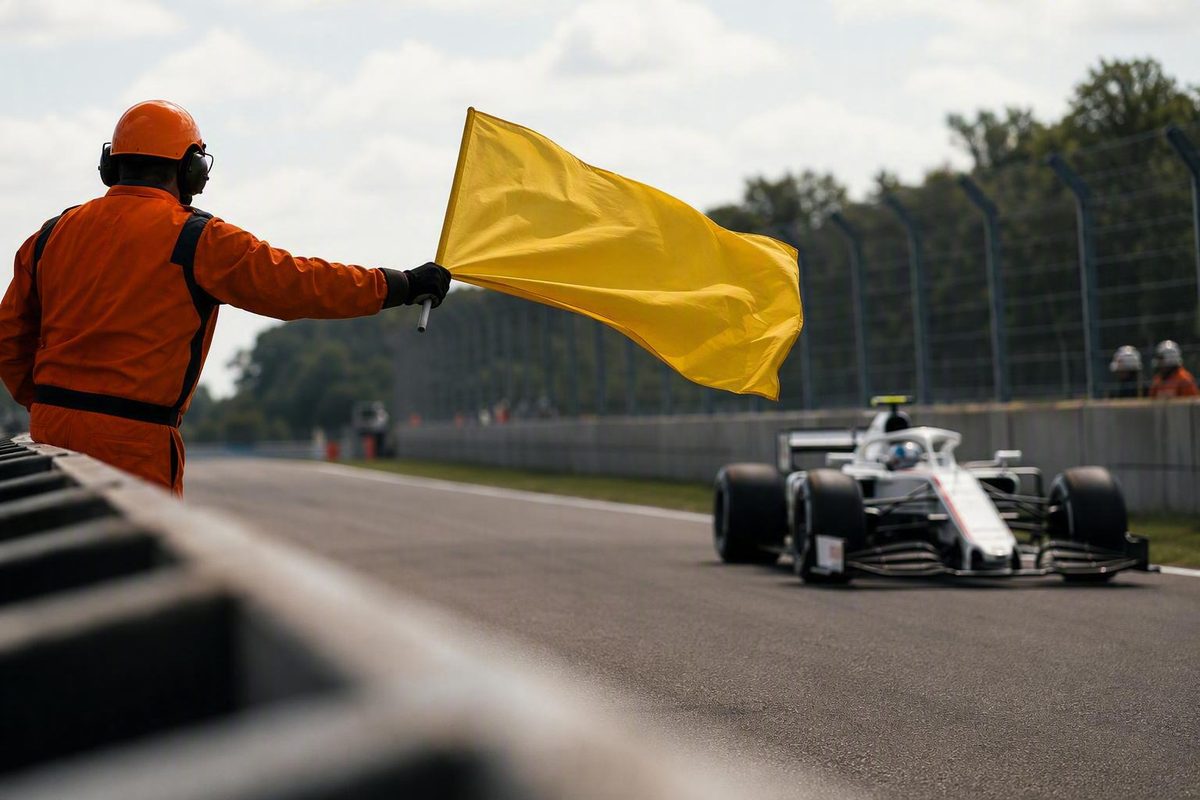
Documented cases range from zero licence points for a heavily mitigated single-yellow breach to two for overtaking under double yellows.
The documented 2026 decisions do not show a universal FIA penalty-points tariff for yellow-flag infringements. In the cases available through the Dutch Grand Prix, the observed outcomes ranged from no Super Licence points for a heavily mitigated single-yellow breach to two points for overtaking under double yellows. The flag condition mattered, but so did the conduct, danger, warning time and mitigation recorded by the stewards.
The short answer: zero, one or two points in the documented 2026 cases
No points, one point and two points all appeared as outcomes in the documented sample through the 2026 Dutch Grand Prix. They should not be treated as an exhaustive legal range or as a formula in which a single yellow automatically means one point and double yellows automatically mean two.
The central comparison is:
| Driver and event | Conduct | Sporting sanction and licence points | Context and evidence |
|---|---|---|---|
| Lewis Hamilton, British GP | Failed to make a discernible speed reduction under a single yellow | Reprimand; 0 points | Very limited warning and reaction time; FIA decision |
| Franco Colapinto, Dutch GP | Failed to slow under a single yellow at Turn 3 | 10-second penalty; 1 point | Considered neither dangerous nor egregious; FIA decision |
| Franco Colapinto, Dutch GP | Overtook Car 22 under double yellows | Drive-through; 2 points | Significant debris accepted as mitigation; FIA decision |
| Arvid Lindblad, Dutch GP | Reportedly passed Pierre Gasly under double yellows | Drive-through; 2 points | Secondary reporting |
| Liam Lawson, Dutch GP | Reportedly failed to slow under yellow flags at Turn 3 | 10-second penalty; 1 point | Secondary reporting |
This table is a dated comparison of identified cases through the Dutch Grand Prix, not a complete tracker for the whole 2026 season. The Lindblad and Lawson entries come from RacingNews365’s Dutch Grand Prix penalty report, rather than the underlying FIA decisions.
The practical answer is therefore not a single number. A yellow-flag infringement can produce different sporting sanctions and different licence-point outcomes according to the facts recorded in the individual decision.
Colapinto’s two Dutch GP decisions show the difference
Franco Colapinto added three Super Licence points at the Dutch Grand Prix, but they came from two separate infringements rather than one three-point penalty.
In the first case, Colapinto overtook Car 22 in a double-yellow sector before the line at the end of Lap 1. The stewards identified a breach of Article B1.8.4b and imposed a drive-through penalty plus two Super Licence points. They recorded that the infringement would normally require a 10-second stop-go penalty, but accepted significant debris on the circuit as mitigation and reduced the immediate sporting sanction to a drive-through. The two licence points remained part of the decision, bringing his stated 12-month total to three (FIA decision on Car 43 overtaking under yellow flags).
The second case concerned a single yellow at Turn 3. Colapinto failed to slow despite a warning visible on his dashboard. The stewards cited Article B1.8.4a and imposed a 10-second time penalty plus one Super Licence point. They considered the infringement neither dangerous nor egregious and selected a penalty at the lower end of the scale. The additional point brought his stated 12-month total to four (FIA decision on Car 43 failing to slow for yellow flags).
The decisions provide the calculation directly:
- Before the two Dutch awards, Colapinto had one active point.
- The double-yellow overtake added two, producing the first decision’s stated total of three.
- The single-yellow failure to slow added one, producing the second decision’s stated total of four.
1 previous point + 2 points + 1 point = 4 active points
A snapshot purporting to show Colapinto on three points immediately after both decisions would therefore be incomplete. A later official review or amendment could, of course, change a previously reported total.
The contrast between the two incidents also shows why the race sanction and the licence award must be read separately. Mitigation reduced the sporting sanction for the double-yellow overtake from the stewards’ stated normal penalty to a drive-through, but the decision still imposed two licence points. In the single-yellow case, the stewards’ assessment that the conduct was not dangerous or egregious supported a lower-end sanction of 10 seconds and one point.
Those combinations describe these decisions. They do not establish mandatory pairings for every comparable infringement.
2026 yellow-flag case table: conduct, race penalty and licence points
The comparison table above contains the five cases central to this analysis. Colapinto’s two rows are supported by separate FIA decisions, while the Lindblad and Lawson rows are identified as secondary reporting.
Hamilton’s British Grand Prix case provides the clearest counterexample to the idea that every failure to slow under a single yellow earns one point. The stewards still found that he had not made a discernible reduction in speed and had not fully complied with the single-yellow requirements. The infringement finding was not erased.
What changed the outcome was the warning available to him. Hamilton entered the relevant sector before a yellow flag or yellow light panel was displayed. The steering-wheel indication appeared only when he was already on the straight and close to the end of the yellow zone, leaving very little time to react. The stewards accepted the limited warning and reaction time as substantial mitigation, imposing a reprimand without Super Licence points (FIA decision on Car 44 failing to slow).
The documented cases consequently support two distinctions:
- A failure to slow under a single yellow did not invariably produce one licence point.
- A finding that a driver committed an infringement did not invariably produce licence points at all.
The flag condition helps define the nature of the incident, but it does not determine the complete outcome by itself. The decisions and reports distinguish between failing to slow and overtaking, while the stewards’ reasoning also refers to factors such as danger, warning time and mitigation.
A full active-points standings table would add little here and could quickly become misleading. Such standings need a precise cutoff because later decisions can add points and each existing award has its own expiry date.
Penalty points are separate from the sporting sanction
An event sanction and FIA Super Licence penalty points are different consequences.
Depending on the infringement, it can take the form of a reprimand, a time penalty, a drive-through or a stop-go penalty. In practice or qualifying, a lap time may also be deleted.
Super Licence penalty points are recorded separately against the driver’s licence and contribute to a rolling total. They are not seconds added to a race time and cannot be calculated from the severity or name of the sporting sanction.
Colapinto’s decisions illustrate the two layers. His double-yellow overtake produced both a drive-through and two licence points. His separate failure to slow produced a 10-second penalty and one licence point. Hamilton’s case separated the layers differently: the stewards issued a reprimand for the infringement but no licence points.
There is therefore no valid conversion formula. A 10-second penalty is not another name for one point, and a drive-through is not inherently equivalent to two. Those pairings occurred in the Dutch Grand Prix cases, but the stewards recorded the sporting and licence consequences independently.
When calculating a driver’s active points, count only an explicit Super Licence penalty-point award. Do not add time penalties, reprimands, drive-throughs or deleted laps to the licence total.
How the rolling 12-month total works
F1 penalty points do not simply clear when the championship season ends. A July 2026 GPFans explainer reported that each award remains active for one year and that reaching 12 points within the rolling 12-month window results in a one-race ban (GPFans’ post-Hungarian Grand Prix penalty-points explainer). This is an attributed explanation of the system, rather than a quotation from the applicable International Sporting Code.
Because the window rolls continuously, a total can fall without a new stewarding decision. For example:
- Two points awarded on 1 May remain active into the following season.
- Three points awarded on 20 August would raise that driver’s total to five.
- The original two would expire the following 1 May, leaving three if no other awards or removals had occurred.
Each group of points has its own offence date. There is no single end-of-season reset.
Colapinto’s Dutch decisions provide a useful calculation without requiring a complete standings table. The double-yellow decision said its two-point award brought his 12-month total to three. The later single-yellow decision said its one-point award brought the total to four. Read in sequence, they establish that he had one active point before the Dutch awards and added three at the event.
This is why every standings table needs an exact cutoff. New decisions can increase a total, points expire individually, and an underlying decision may later be changed. A post-Hungarian table and a post-Dutch table can both have been accurate at their respective cutoffs while showing different figures.
Can an F1 yellow-flag infringement cause a lap-time deletion without Super Licence points?
A lap-time deletion does not, by itself, establish that Super Licence points were awarded.
The FIA’s Formula 1 document index lists separate 2026 Spanish Grand Prix documents for yellow- or double-yellow-related lap deletions in Free Practice 1, Free Practice 3 and qualifying. Those document titles establish that lap-time consequences were recorded, but the index alone does not show whether any licence points accompanied them (FIA Formula 1 decision-document index).
A deleted lap should therefore be recorded as a session consequence unless the underlying decision explicitly states that Super Licence points were also imposed. The absence of a points reference in an index title is not proof that the outcome carried zero points.
Can FIA Super Licence penalty points be removed after they are awarded?
Yes, when the decision supporting the points is later rescinded. Formula 1’s penalties guide cites Carlos Sainz’s successful Right of Review after the 2025 Dutch Grand Prix as an example in which the associated penalty points were removed.
That is different from ordinary expiry. Expiry occurs when an award reaches the end of its rolling 12-month period; rescission removes the points because the underlying decision has been overturned.
The reliable method is to check the individual stewards’ decision rather than infer licence points from the flag colour or race penalty. In the clearest 2026 comparison, Colapinto received two points for overtaking under double yellows and one for a separate failure to slow under a single yellow, while Hamilton’s heavily mitigated single-yellow breach produced no licence points.