
Overtaking Has Increased, but the Cars Are Not Racing Unaided
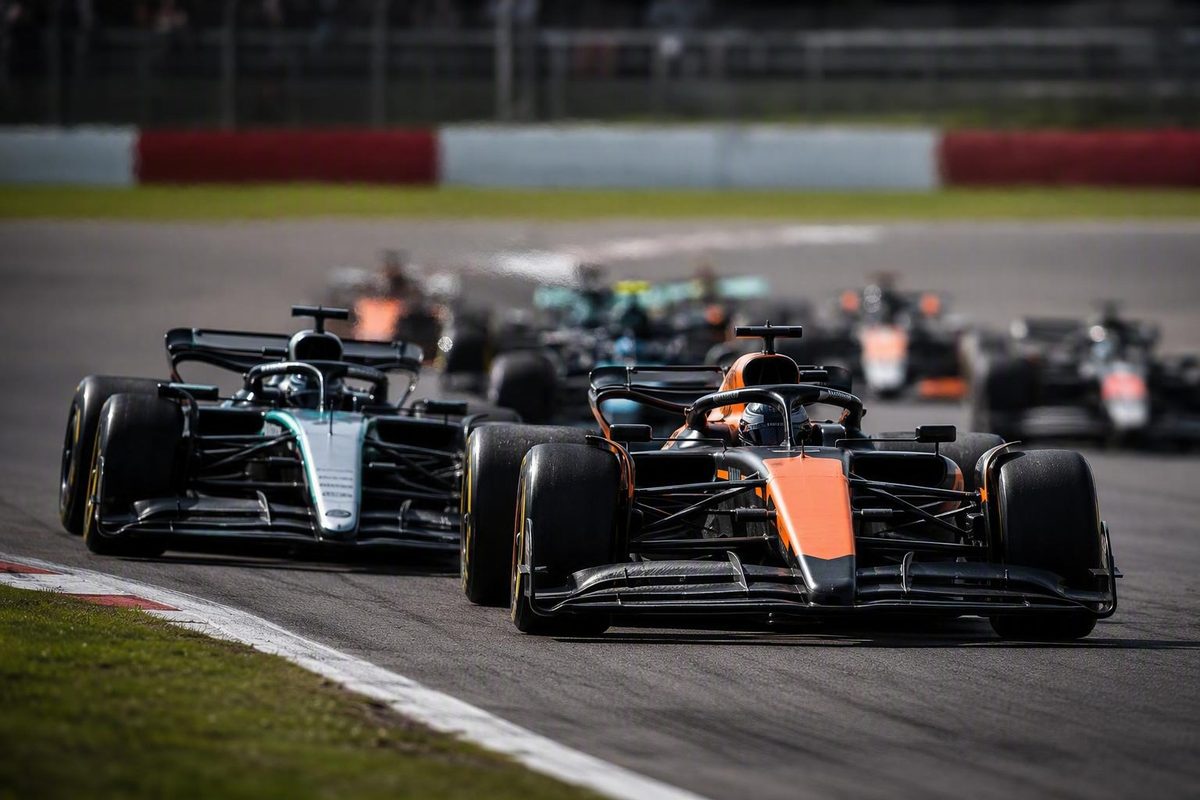
A four-race comparison reported 203 passes versus 84 in 2025—but Active Aero, Overtake Mode and Boost leave the unassisted total unknown.
This is an early-season finding, not a season-wide verdict. Across Australia, China, Japan and Miami, one analysis counted 203 overtakes in 2026 against 84 in the corresponding 2025 races—a reported increase of 141.7% (ScuderiaFans’ four-race comparison).
That shows substantially more reported passing in those four events. It does not show how many moves were genuinely unassisted or prove that the 2026 regulations caused the increase.
The short answer: more reported passes, but no count of unassisted overtakes
But “without DRS” and “without assistance” are not equivalent descriptions.
The 2026 cars no longer relied on the former DRS system. They could instead reduce drag through Active Aero, gain an attacker-specific electrical advantage through Overtake Mode and deploy stored energy through Boost. Differences in battery state, tyre condition and race strategy could also create the speed offset needed to pass.
The ScuderiaFans comparison has three important limits:
- It covers four races rather than the complete 2026 season.
- It does not disclose its overtaking-count methodology.
- It does not classify passes by Active Aero, Overtake Mode, Boost or no identifiable assistance.
The evidence therefore supports a narrow conclusion: reported overtaking increased substantially across the four selected races, while the number of genuinely unassisted overtakes remains unknown.
Nor can the comparison establish causation. A higher total after a rule change does not, by itself, prove that the rule change produced the difference. Weather, tyre degradation, safety-car timing, recovery drives and unusual starting orders can all alter the number of passes in an individual race.
What replaced DRS in 2026?
DRS combined two functions. It opened a rear-wing flap to reduce drag, and under normal race conditions it reserved that benefit for a pursuing car that met the relevant proximity requirement.
The 2026 system separates the aerodynamic and attacker-specific functions. Active Aero provides the lower-drag configuration for all cars in designated sections. Overtake Mode provides an additional electrical advantage to an eligible pursuer. Boost is a separate driver-controlled deployment tool that can support either attack or defence.
| System | Who can use it? | Eligibility | Effect and race role |
|---|---|---|---|
| Former DRS | A pursuing driver | Required gap at a detection point and use in an enabled zone | Opened a rear-wing flap to reduce drag; primarily an attacking aid |
| Active Aero | Every driver | Designated straight-line sections; no proximity requirement | Opens front- and rear-wing elements to reduce drag and improve straight-line efficiency |
| Overtake Mode | A qualifying pursuer | Proximity condition at the detection point | Adds energy availability and an electrical-power profile intended to sustain speed for longer |
| Boost | Any driver | Sufficient stored electrical energy | Changes energy deployment for attack or defence |
Formula 1’s technical explanation says a driver within one second of the car ahead at the detection point can receive an additional 0.5 megajoules of recharge and use an extra electrical-power profile on the following lap. Active Aero, by contrast, does not require a one-second gap, while Boost can deploy saved energy when sufficient charge is available (Formula1.com’s guide to the 2026 terminology).
Active Aero alone is therefore not the direct equivalent of DRS. It replaces DRS’s drag-reduction function, but it is generally available to both the attacking and defending cars. Overtake Mode supplies the pursuer-specific advantage.
Boost adds another tactical variable. A driver can save electrical energy and deploy it when attacking, but the car ahead can also use stored energy defensively. Because the available energy is finite, earlier harvesting and deployment decisions can influence the speed difference once a battle begins.
Illustrative sequence—not a reconstruction of a particular pass:
- A pursuing driver reaches the detection point within the applicable gap.
- The driver gains Overtake Mode eligibility for the following lap.
- The driver chooses how to use the available energy and advantageous power profile.
- Both cars can reduce drag with Active Aero in the applicable straight-line sections.
- The defending driver may respond with Boost if sufficient energy has been stored.
- The outcome depends on deployment, battery state, tyres, positioning and circuit layout.
DRS operated through 2025, while the detailed conditions governing the new system can include circuit-specific detection gaps, activation arrangements and operational restrictions. Overtake Mode may also be unavailable or disabled in specified circumstances, so the general one-second explanation should not be treated as proof of an identical procedure at every Grand Prix (technical explanation of Overtake Mode).
What the early 2026 overtake numbers show
The central comparison was published on May 17, 2026 and covers Australia, China, Japan and Miami. It is a preliminary snapshot rather than evidence of a season-long trend.
| Measure | 2025 | 2026 |
|---|---|---|
| Australia, China, Japan and Miami combined | 84 | 203 |
| Japanese Grand Prix | 15 | 43 |
| Australian Grand Prix | — | Described separately as nearly three times 2025 |
The four-race increase was reported as 141.7%, while Japan’s rise from 15 to 43 was reported as 186.7% (four-race figures and publication date).
A separate analysis from The Race described the Australian Grand Prix total as nearly three times its 2025 level. It also warned that strategy conflicts and energy-management differences can generate passing without necessarily producing prolonged competition between evenly matched cars (The Race’s Australian Grand Prix analysis).
These figures cannot establish whether the increase persisted beyond the four selected events. They also should not be treated as a controlled comparison unless the same counting rules were applied throughout.
The available reporting does not establish that every source and season used an identical definition.
Why an overtake total cannot identify passes made without assistance
A race total records how many qualifying position changes occurred under a chosen definition. It does not explain the mechanism behind each one.
None of the cited race totals classifies overtakes by Active Aero, Overtake Mode, Boost or no assistance. Driver rankings do not resolve that problem either.
Measure’s live tracker says it derives genuine on-track passes from official lap-by-lap classifications and excludes pit-stop position changes. At its stated post-Spanish Grand Prix update, it listed Gabriel Bortoleto on 76 overtakes, Max Verstappen and Nico Hülkenberg on 73, and George Russell and Franco Colapinto on 71. The tracker’s description of the round is ambiguous, and because the page is live, those figures are only a dated snapshot (Measure’s 2026 driver overtake tracker).
More importantly, such a tracker measures volume rather than mechanism. It does not identify which aerodynamic or electrical systems were active during a move.
A defensible assistance classification would require pass-level records containing at least:
- The lap and corner where the position changed.
- The cars involved in the move.
- Confirmation that the change occurred on track.
- Tyre compounds, tyre ages and relevant pace differences.
- Battery state and electrical deployment for both cars.
- Overtake Mode eligibility and actual use.
- Active Aero state during the approach and pass.
- Relevant weather, neutralisation, reliability and strategy context.
This also explains why positions gained and overtakes are different measures. A driver can move forward when another car pits, retires, receives a penalty or drops out of the classification. Those changes affect race position without necessarily constituting an on-track pass.
Even “on-track overtake” does not mean “unassisted overtake.” A legitimate pass may still have been influenced by Overtake Mode, an energy advantage, fresher tyres or depleted battery charge in the defending car.
Monza shows why individual passes need context
Monza provides a useful baseline, but not a complete year-on-year comparison.
Before the 2026 active-aero race, Formula1.com reported that the 2025 Italian Grand Prix had produced 47 overtakes (Formula1.com’s 2025 Monza baseline). No comparable 2026 total is established here, so the baseline cannot show whether overtaking at Monza subsequently increased or decreased.
The 2026 race nevertheless illustrates why an individual pass needs more context than a result sheet can provide. Kimi Antonelli started 19th after an engine penalty, passed Max Verstappen for the lead on lap 15, passed George Russell on lap 18 and won. A Virtual Safety Car pit stop had put Antonelli on fresh medium tyres while Russell remained on worn hard tyres.
The report confirms that both passes happened. It does not identify whether Antonelli used Overtake Mode, Boost or another advantageous deployment profile for either move.
Classifying the passes as assisted would therefore go beyond the evidence. So would classifying them as unassisted. The tyre difference and Virtual Safety Car timing also mean the result cannot be credited solely to Antonelli’s ability to pass other cars.
The case study shows the distinction between confirming and explaining an overtake:
- Confirmation: Antonelli passed Verstappen and Russell on track.
- Explanation: The report supplies tyre and strategic context but not enough system-state data to isolate the contribution of the 2026 overtaking tools.
A pass can be clear from race reporting and lap classifications while its causes remain uncertain without telemetry and deployment data.
More overtakes do not automatically mean better racing
An overtake count measures completed position changes under a particular definition. It does not measure how long drivers fought, how difficult the moves were or whether the cars could remain close after a pass.
Weather can reorder the field or create large pace differences. Tyre degradation can put drivers on incompatible strategies. Safety Car and Virtual Safety Car timing can create advantageous pit stops and fresh-tyre recovery drives. Reliability problems can leave fast cars out of position. Battery deployment can also produce a substantial speed mismatch between cars with otherwise similar pace.
All of those circumstances can generate legitimate overtakes. But one car passing another because it has much fresher tyres or more usable electrical energy is not analytically identical to a sustained fight between evenly matched cars. Both still add one to the total.
The evidence supports three distinct findings:
- Reported passes increased: The four-race 2026 total was considerably higher than the corresponding 2025 figure.
- The cause has not been isolated: The comparison does not separate regulatory effects from tyres, weather, safety cars, strategy, field order or counting choices.
- Racing quality is a separate question: A larger total alone cannot show whether battles became closer, longer or more competitive.
A stronger evaluation would apply consistent counting rules across seasons and compare equivalent races. Events affected by abnormal weather, lengthy neutralisations, major recovery drives or severe reliability disruption should be identified rather than treated as directly interchangeable.
Each completed pass could then be classified by tyre offset, energy offset, Overtake Mode use and passing location. Battle duration would add another useful measure: how many corners or laps did the drivers remain within attacking range before and after the move? Failed attacks also matter because sustained pressure can indicate close racing even when no position changes.
Those passes occurred under a system without the former DRS, not without other assistance. Determining how many were genuinely unassisted—and how much of the increase resulted from the new regulations—requires pass-level data showing which aerodynamic and electrical systems were active during every overtake.