
Why a Driver’s Pass Count Rarely Matches Their Grid-to-Finish Gain
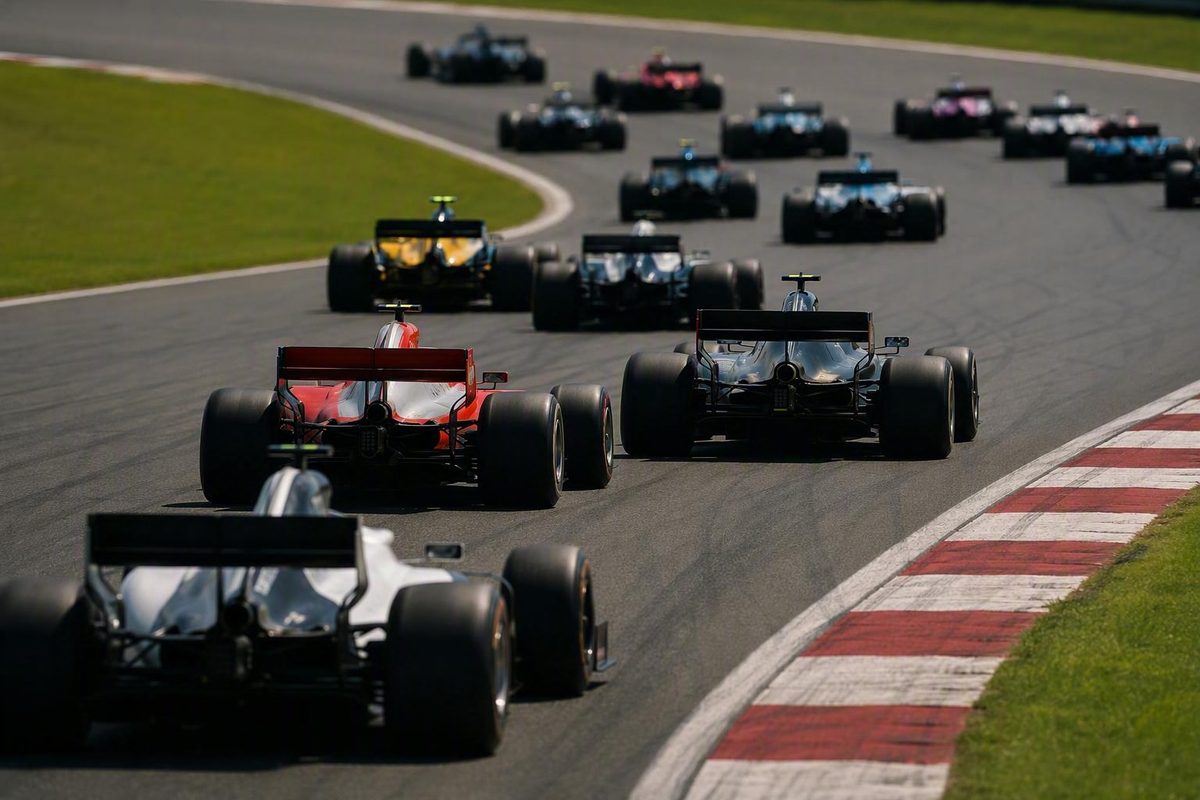
One logs eligible passing events under provider rules; the other is the net change from the official starting grid to the finish.
F1 overtakes and positions gained measure different things. An overtake total counts passing events that meet a provider’s rules. Positions gained normally records the net difference between a driver’s official starting-grid slot and finishing position.
The short answer: event count versus net result
| Metric | What it measures |
|---|---|
| Overtakes | Passing events that satisfy a stated counting methodology |
| Positions gained | Net improvement from the official starting grid to the finishing classification |
Under the official F1 Fantasy game rules, the normal calculation is:
Positions gained = official starting-grid position − finishing position
A driver who starts P15 and finishes P12 has therefore gained three positions:
15 − 12 = 3
The official grid matters because it can differ from the qualifying result after grid penalties. Other providers may handle pit-lane starters, unclassified drivers or amended classifications differently, so the baseline should always be checked.
F1 Fantasy also scores valid overtakes and positions gained as separate categories. One records eligible passing events; the other records the net outcome between the grid and finish.
Those rules are authoritative for the Fantasy game, not a universal FIA definition governing every historical database, broadcast graphic or third-party statistical product.
How the two numbers can move in opposite directions
Consider this race timeline:
- A driver starts P15.
- They complete six eligible on-track passes.
- They later lose three places.
- They finish P12.
Their totals are:
- Overtakes: 6
- Positions gained: 15 − 12 = 3
The six passes remain events in the race record, even though three of the places were subsequently lost. Positions gained cancels gains against losses; an overtake count does not necessarily do so.
Repeated exchanges can make the gap larger. If two drivers pass and repass one another several times before finishing near their original positions, each eligible move may add to the overtake tally while producing little or no net grid-to-finish change.
The reverse is also possible. A driver can move forward because a rival retires, fails to start, makes a mistake, serves a penalty or falls behind during a pit sequence. The beneficiary may gain a position without directly passing that car on track.
A clear example came in China, where Oscar Piastri and Lando Norris did not take their P5 and P6 grid slots. Drivers behind them initially appeared to have gained two first-lap places despite making no overtakes. F1.com adjusted the starting order by removing the two DNS cars, preventing those “ghost” gains from distorting its start data.
The distinction is between gross movement and net movement. Overtakes describe individual eligible moves. Positions gained compresses the race into two data points: where the driver started under the selected methodology and where they finished.
What counts as an overtake depends on the methodology
Not every running-order change is an overtake. The boundaries depend on who compiled the statistic.
| Position change | Reported award criteria | Possible treatment elsewhere |
|---|---|---|
| Direct same-lap on-track pass | Counts if otherwise eligible | Usually counts |
| Change during a pit cycle | Excluded | Commonly filtered out |
| Passing a lapped car | Excluded | Depends on the dataset |
| Rival retires or suffers a failure | Excluded | May appear as a raw swap |
| Safety-car or red-flag change | Excluded | Depends on flag filters |
| Eligible opening-lap pass | Counts | Some methods exclude early laps |
For the particular F1 overtaking award covered in The Race’s report, both cars had to be on track and on the same lap. Pit-lane changes, passes of lapped cars, and changes caused by failures, retirements, safety cars or red flags were excluded. Eligible opening-lap moves counted because the grid order served as the first timing point, according to the reported award criteria.
That is an award-specific approach, not a universal rule. One independent timing-based method compares the order at successive lap ends, excludes the first two laps and applies pit-stop, running-status and green-flag filters. Its treatment of the 2023 Dutch Grand Prix shows how much those filters matter: 374 raw lap-to-lap swaps became 72 after pit-related exclusions and 65 after the green-flag rule was applied.
Timing-point methods also have blind spots. A pass reversed before the next timing point may disappear entirely. Conversely, timing alone may not reveal whether a move was contested, ordered by a team or conceded because the other car had damage.
Any overtake number is therefore incomplete without its counting rules.
Antonelli’s 19th-to-first Monza drive: 18 positions gained, not a verified pass total
Kimi Antonelli started P19 and finished P1, giving him a net gain of 18 positions:
P19 start − P1 finish = 18 positions gained
That calculation is supported by the FIA’s account of Antonelli’s Monza win. It is a net result, not an overtake count.
The same report explains why the totals cannot be treated as equivalent. It describes Antonelli passing several rivals, later passing some of them again, repeatedly exchanging places with George Russell, changing position through pit sequences and racing amid mistakes and retirements.
The report identifies several passes, but it is a race narrative rather than an exhaustive pass-by-pass dataset. It does not provide an official overtake total or define a counting methodology.
A Reddit post claimed Antonelli made 26 overtakes and set a single-race record. The post did not disclose the underlying dataset or rules needed to reproduce either assertion, so neither the 26-pass figure nor the record claim is verified.
The firm conclusion is narrower: Antonelli gained 18 net positions. Any claimed overtake total must be attributed to the provider that counted it and accompanied by that provider’s methodology.
How to read an F1 overtake statistic responsibly
Before comparing drivers, races or supposed records, check:
- Starting point: official grid, qualifying result, pit-lane order or first timing line?
- Opening lap: included, partly included or excluded?
- Timing points: mini-sectors, sector lines or end-of-lap order?
- Pit activity: are in-laps, out-laps and pit-lane changes removed?
- Flag conditions: do safety-car, virtual-safety-car and red-flag changes count?
- Lapped traffic: must both drivers be on the same lap?
- Failures and incidents: are conceded places excluded?
- Pass retention: must the move remain in place at a later timing point?
- Repasses: does every eligible exchange count separately?
If those rules are undisclosed, describe a record as provider-specific, not as an official or universal F1 record. Totals produced by different filters—and especially totals from different regulation eras—should not be compared as though they came from one continuous dataset.
The two metrics answer different questions:
- Positions gained: How much better or worse was the finishing position than the selected starting baseline?
- Overtakes: How many eligible passing events did the selected methodology detect?
Neither isolates driver ability. Starting position, car pace, tyre strategy, reliability, circuit layout, incidents and race state influence both. Neither metric alone measures how difficult a pass was, how long a driver sustained pressure or how well another defended. A compelling fight can end without a position change, while repeated low-resistance exchanges can create a large pass count.
The clearest reporting presents both figures together: eligible overtakes under a named method, plus net positions gained from the official grid, with brief context for pit stops, incidents, retirements and repasses.
The practical rule is to calculate positions gained from the stated starting baseline—normally the official grid—to the finishing classification, while treating every overtake total as provider-defined. Antonelli’s P19-to-P1 Monza drive securely establishes an 18-place gain; by itself, it verifies neither 18 nor 26 nor any other number of overtakes.