
How an F1 Driver Can Retire and Still Keep a Race Position
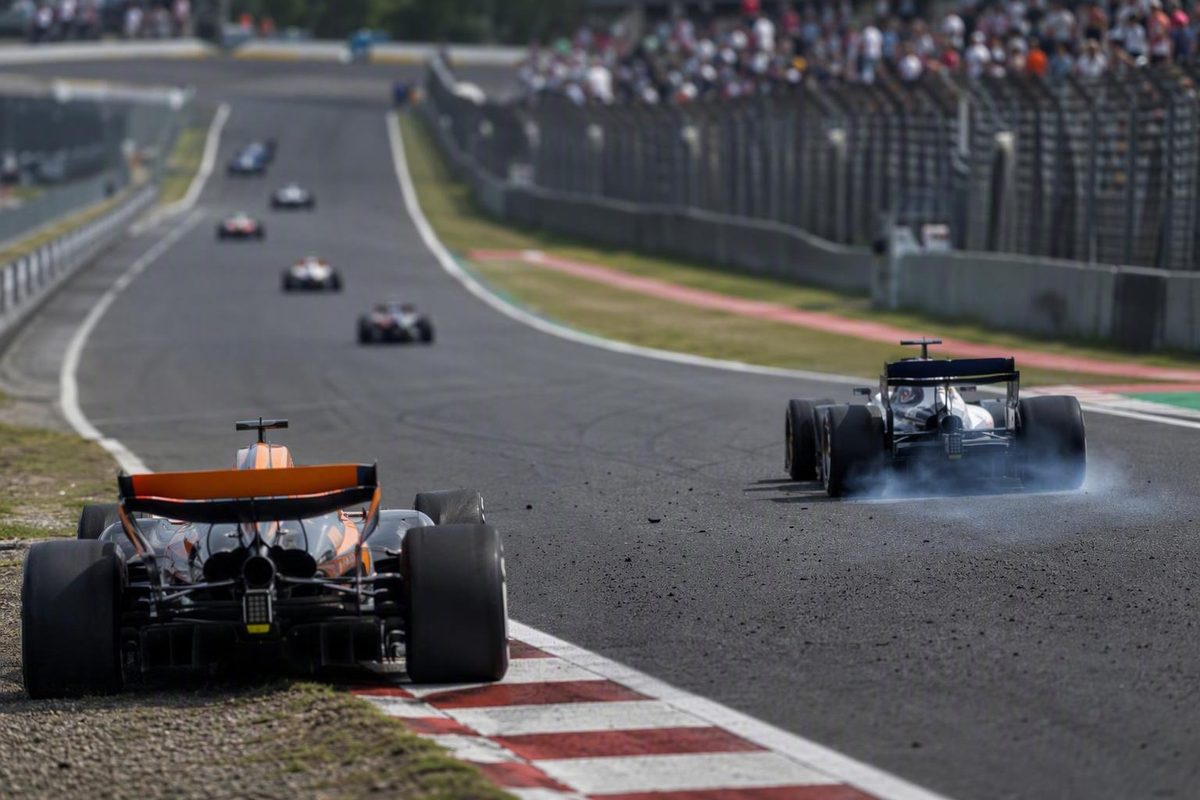
One records that the car stopped participating; the other determines its official place, so a sufficiently late DNF can remain ranked without taking the flag.
An F1 driver can retire from a race and still hold a classified position because retirement and classification describe different things. Retirement records that the car stopped participating before completing the race normally. Classification records where the driver ranks in the official result. A sufficiently late retirement can therefore remain classified even though the driver does not take the chequered flag.
The short answer: a driver can be retired and classified
Read the result on two separate axes:
- Track status: Was the car still running at the finish, or had it retired?
- Classification status: Did the driver satisfy the applicable requirement for a place in the classified order?
Those answers do not have to match. A driver can be running and classified, retired and classified, or retired and not classified. Disqualification is different because it follows an official decision affecting or invalidating the result. This distinction between stopping and retaining a classified place is also reflected in secondary explanations of F1 result terminology.
That is why “classified despite retiring” is generally more precise than “classified finisher.” The latter can sound as though the driver physically reached the finish, which is not necessarily true.
| Track status | Classification status | Likely description | Possible points eligibility |
|---|---|---|---|
| Running at the finish | Classified | Finished | Yes, if the final position pays points |
| Retired late | Classified | Retired/DNF but classified | Potentially |
| Retired too early | Not classified/NC | DNF or not classified | No position-based points under the reported threshold account |
| Finished or stopped, then excluded | Disqualified/DSQ | Disqualified | Result and points depend on the official decision |
The essential distinction is that “retired” describes what happened to the car, while “classified” describes the driver’s standing in the official result.
How the reported 90% classification threshold works
A modern secondary explanation describes the cutoff as at least 90% of the winner’s completed laps, with the calculated threshold rounded down to a whole number. Under that account, a driver who reaches the threshold may remain classified after retiring, while one below it may be unclassified. The same source connects classification with eligibility for position-based points and distinguishes this individual-driver test from separate rules for shortened events (Formula One History’s explanation of the 90% rule).
In compact form, the reported calculation is:
Classification threshold = winner’s completed laps × 0.90, rounded down to a whole lap
This is a secondary-source summary, not a quotation of the operative 2026 provision. The published 2026 FIA Formula 1 Sporting Regulations, Section B, Issue 06 are dated 27 April 2026, record World Motor Sport Council approval on 28 April 2026, and identify Article B5.16 as the finishing procedure for total-time-classified sessions.
For any particular Grand Prix, use the regulations applicable to that season and the final official classification. Sporting rules can be amended, reorganized or renumbered, so the reported formula should not replace the governing edition for a disputed result.
Worked examples: where the cutoff falls
Suppose the winner completes 52 laps. Applying the reported formula gives:
52 × 0.90 = 46.8
Rounded down = 46 laps
A driver credited with 46 laps therefore reaches the reported threshold. A driver credited with 45 laps does not.
A reported real-world example comes from the 2023 British Grand Prix. Pierre Gasly retired after being credited with 46 of the race’s 52 laps but remained classified. The secondary account calculates the cutoff as 46.8 laps rounded down to 46 (FanAmp’s Gasly classification example).
Now consider a race in which the winner completes 70 laps:
70 × 0.90 = 63
No fractional-lap adjustment is necessary. Under the same reported formula:
- 63 laps meets the threshold.
- 62 laps falls below it.
The calculation uses the winner’s credited lap total, not necessarily the race’s originally scheduled distance. These examples demonstrate the secondary account of the formula; they do not substitute for checking the regulations and official classification applicable to a specific Grand Prix.
Why a retired car can rank ahead of a running car
Race order reflects credited distance and the applicable ordering procedure, not merely whether each car is moving when the chequered flag appears.
Consider a bounded hypothetical:
- Driver A retires late and is credited with 60 laps.
- Driver B remains on track but is credited with 59 laps.
- Both satisfy the applicable classification requirement.
Driver A can be classified ahead of Driver B because A covered more of the race. B’s presence on track at the finish does not erase the one-lap deficit.
That is the practical reason a late retirement can retain an official position, including one ahead of cars credited with fewer laps. The stopped car has already travelled farther than those cars, so retirement does not automatically move it to the bottom of the result.
This reasoning should not be extended to drivers credited with the same number of laps. Their order depends on the procedure in the applicable regulations and official classification, rather than on an assumed tie-breaking method.
What classification means for championship points
Retirement alone does not automatically eliminate a driver from position-based points eligibility. Under the cited secondary explanation, a classified retiree may score if the final position pays points and no penalty, disqualification or other applicable rule removes that eligibility.
Three conditions must therefore be kept separate:
- The driver must satisfy the applicable classification requirement.
- The final classified position must carry points.
- No subsequent decision or other rule may remove or change the result.
For example, if an attritional race leaves a driver classified tenth despite a late retirement, that driver may remain eligible for the points attached to tenth place. Under the reported 90% account, however, a driver below the classification threshold is not eligible for position-based points simply because only a few other cars remain.
The individual classification test is separate from event-level points rules. If a race is suspended, shortened or cannot be resumed, other provisions determine whether the event awards full, reduced or no points. One question concerns whether an individual driver belongs in the classified order; the other concerns how many points are available from the event. They are not the same calculation.
Classified, DNF, NC, and DSQ are not interchangeable
Classified means the driver has an official position in the race classification. It does not necessarily mean the car crossed the finish line or was running when the winner finished.
DNF means Did Not Finish. It describes a driver who did not complete the race normally, but it is not necessarily synonymous with “not classified.” A sufficiently late DNF may still retain a classified position.
A DNF also does not establish fault. A retirement can result from mechanical failure, accident damage, overheating, brake trouble, a puncture or a team decision. The label records the outcome, not who caused it.
Not classified, often shortened to NC, means the driver did not satisfy the applicable classification requirement. The presentation can vary between result sheets, and an entrant may still be listed on a document with an explanatory status despite being outside the classified order.
DSQ means disqualified. It is not another word for retirement. Disqualification follows an official decision affecting or invalidating a competitor’s result.
When reading a result, the four principal cases are:
| Situation | What happened on track? | Official-result question | Conditional points outcome |
|---|---|---|---|
| Running at the finish and classified | Car reaches the end normally | Driver holds a classified place | Eligible if the position pays points |
| Retired after reaching the threshold | Car stops before the finish | Driver may remain classified | May remain eligible |
| Retired below the threshold | Car stops without sufficient credited distance | Driver is unclassified under the applicable rule | No position-based points |
| Disqualified by official decision | Car may finish or retire | Result is affected or invalidated by the decision | Associated points may be removed or changed |
Where are official F1 race classifications published?
The FIA states that classifications and results for the race and other sessions are published through its Document Management System. For a definitive reading of an individual result, consult the final FIA classification together with any later official decisions that affect it.
If every other car retires, can the final running driver simply stop and win?
Not automatically. The classification threshold alone cannot resolve that scenario. The outcome may also depend on the applicable finishing, suspension, termination and ordering provisions. The frequently discussed sole-remaining-car hypothetical is a fan question, not an official ruling.
The durable distinction is simpler: a driver may have retired on track but still hold a classified position in the result. Check the season-specific FIA regulations and final official classification rather than treating “DNF,” “retired” and “not classified” as automatic synonyms.