
How Formula 1 and IndyCar Take Different Paths to Open-Wheel Racing
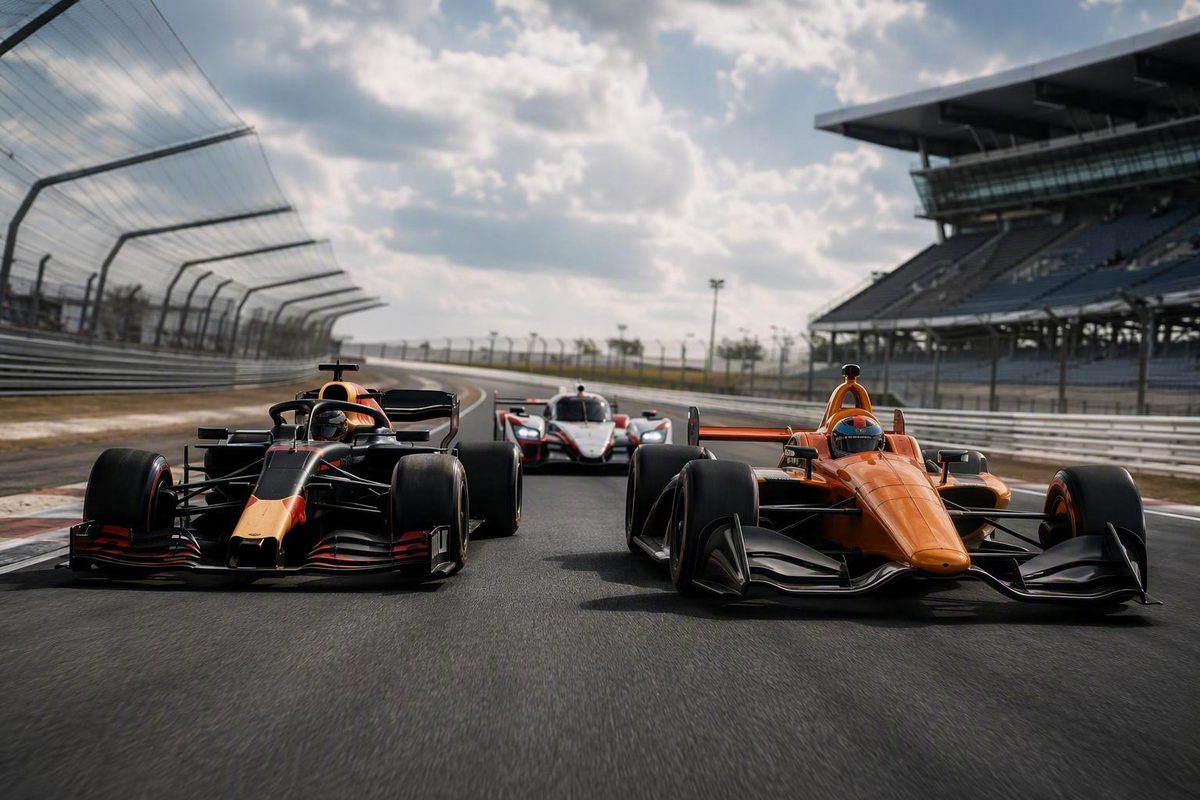
F1 teams design distinct cars; IndyCar uses a standardized platform across road, street and oval circuits. Speed depends on peak velocity versus lap time.
Formula 1 and IndyCar are elite single-seat, open-wheel championships, but they create competition differently. F1 is constructor-led: teams design distinct cars within a technical rulebook and race primarily on permanent road courses and temporary street circuits around the world. IndyCar uses a more standardized technical foundation across road courses, street circuits, short ovals and superspeedways, mainly in North America.
Neither series is universally faster. IndyCar can produce higher peak speeds in oval configuration, while F1 is generally described as quicker over a complete road- or street-circuit lap. The answer depends on the track and, crucially, on what “faster” means.
The difference at a glance
The simplest distinction is constructor-led development versus a shared technical platform used across a broader range of circuit types.
| Category | Formula 1 | IndyCar |
|---|---|---|
| Foundational machinery | Each team develops a distinct car within common technical rules | Teams use a designated chassis and common base components |
| Engineering emphasis | Car design, development and trackside setup | Setup, execution and limited development of prescribed machinery |
| Circuit types | Primarily permanent road courses and temporary street circuits | Road courses, street circuits, short ovals and superspeedways |
| Speed context | Generally quicker over road- and street-circuit laps | Can achieve higher peak speeds in oval configuration |
| Geographic footprint | Internationally distributed | Concentrated primarily in North America |
| Championship emphasis | Drivers compete individually; teams also contest a constructors’ championship | Drivers compete within a series built around a common technical foundation |
These are structural distinctions rather than a complete guide to current regulations. The constructor model and IndyCar’s use of ovals are central to understanding the championships. Points, suppliers, schedules and detailed technical provisions can change between seasons.
Team-designed F1 cars versus standardized IndyCar foundations
The largest technical difference is how much responsibility each entrant has for creating the underlying car.
An F1 team designs and builds its own car within regulatory boundaries. The rules constrain areas including aerodynamics, suspension and electronics, but they still leave room for teams to pursue different concepts. IndyCar teams instead purchase cars from a designated chassis manufacturer and work with common base components, according to James Hinchcliffe’s technical comparison of IndyCar and Formula 1.
That gives an F1 team two connected routes to performance:
- Design and development: Creating the underlying car and improving it where the rules permit.
- Trackside optimization: Adjusting the available settings for the circuit, conditions, tires and driver.
IndyCar begins from prescribed foundational machinery, so teams have much less scope to redesign the car fundamentally.
“Standardized” does not mean every IndyCar is identical in operation or performance. Teams can adjust numerous settings, and Hinchcliffe identifies dampers—the components that control suspension movement—as an important permitted development area. Different engineering decisions can therefore make cars sharing the same chassis behave differently.
The engineering distinction can therefore be summarized without treating either discipline as simple:
- F1: Design a competitive car, develop it within the rules and then optimize it for each event.
- IndyCar: Optimize a common technical foundation through setup, permitted development and execution.
Standardization narrows the scope of original car design.
Why the track calendar changes the comparison
Circuit type is not merely a calendar detail.
For newcomers, the relevant categories are:
- Permanent road course: A purpose-built circuit with a mix of corners and straights, such as Road America.
- Street circuit: A temporary course laid out on public roads, such as Long Beach or Detroit.
- Short oval: A smaller oval, such as Phoenix Raceway or the Milwaukee Mile.
- Superspeedway: A large, high-speed oval that places greater emphasis on sustained speed, aerodynamic efficiency and stability.
IndyCar competes across all four categories. F1 primarily uses permanent road courses and temporary street circuits rather than ovals, a distinction outlined in Hinchcliffe’s comparison of the championships and their schedules.
On a superspeedway, reducing drag while maintaining stability through long, fast turns becomes a priority. On a road or street circuit, the car must repeatedly brake, rotate, change direction and accelerate. Grip, braking performance and traction can matter more to the lap than the maximum speed reached on one straight.
The championships also have different geographic footprints. F1’s calendar is internationally distributed, while IndyCar is concentrated primarily in North America. That describes where they race; it does not establish that either championship is more prestigious or popular.
Which is faster? First define faster
There is no unconditional winner. IndyCar can reach higher peak speeds in low-drag oval configurations, while F1 is generally quicker around road and street circuits. The distinction is supported by a broad comparison of the two series’ cars and tracks, although its headline speed figures are not based on disclosed, matched test conditions and should not be treated as a controlled measurement.
Speed methodology
- Peak speed: The highest instantaneous speed recorded.
- Speed-trap reading: The speed measured at one defined point on a circuit.
- Qualifying lap time: The time required to complete one lap during qualifying.
- Race pace: Repeatable lap performance over a stint, influenced by fuel, tires, traffic and strategy.
- Average race speed: Race distance divided by elapsed time, potentially affected by cautions, safety cars, weather and stoppages.
Those measurements answer different questions. An IndyCar in oval trim may record a higher peak speed without being quicker around a road circuit. Conversely, a faster F1 road-course lap does not demonstrate which car could sustain the greater speed on a superspeedway.
A lap time reflects performance around the whole circuit. Straight-line speed contributes, but so do acceleration, braking distance, cornering grip, aerodynamic load, tires, setup and the sequence of corners. A car can lose terminal speed on a straight yet recover more time through braking zones and corners.
This is also why isolated lap-time comparisons require caution. Results from different layouts, weather conditions, fuel loads, tire states, session types or technical eras do not create a like-for-like test. Even at the same venue, the championships may not use equivalent configurations or encounter comparable conditions.
Race formats: use the Indianapolis 500 carefully
The Indianapolis 500 demonstrates how an oval can shape an event, but it is not a template for the entire IndyCar season. The race comprises 200 laps of a 2.5-mile oval, producing its 500-mile distance:
200 laps × 2.5 miles = 500 miles (Red Bull’s IndyCar and F1 comparison)
That worked example explains the event’s name and distance. It does not mean ordinary IndyCar races follow the same format.
IndyCar’s combination of road courses, street circuits, short ovals and superspeedways prevents one event from representing the championship as a whole. The Indianapolis 500 is a special superspeedway race; other events are shaped by their own circuits and sporting formats.
F1 Grands Prix and IndyCar events should therefore be compared event by event rather than through a single assumed distance or duration. Racing Sheet’s existing guide, How Long Is a Formula 1 Race?, explains the Grand Prix distance framework in detail, but its IndyCar comparison is intentionally brief and should not be read as a complete guide to IndyCar formats.
The practical difference is that F1’s calendar is built primarily around road and street racing, whereas IndyCar must accommodate fundamentally different event environments. That changes not only car setup but also how race distance, traffic and sustained speed influence competition.
Championships, teams and rules that change by season
Formula 1 awards both a drivers’ championship and a constructors’ championship. The latter reflects its constructor-led model: drivers compete for individual results while teams compete through the performance of the distinct cars they design and enter.
The useful IndyCar contrast is not that it lacks competition beyond its drivers. Rather, constructor identity does not occupy the same central position because teams begin with a common chassis and base components. The championship structures therefore reflect different technical foundations.
Team presentation can differ as well. F1 teams field their distinct cars under a constructor identity. Hinchcliffe’s comparison describes IndyCar organizations as able to operate differing numbers of cars and use different liveries within the same team structure. Those details can affect how easily a newcomer identifies which cars belong together, but they do not alter the basic technical distinction.
Check the season
Several details can change and should always carry a season label in a detailed rules comparison:
- points scales, bonus points and title provisions;
- engine, hybrid and other technical rules;
- engine, chassis, tire and other designated suppliers;
- qualifying formats and event-specific procedures;
- tire allocations, usage rules and refueling provisions;
- team counts, entrant counts and field sizes;
- schedules and the balance of road, street and oval events.
Secondary comparisons sometimes combine information from different seasons. A points table, supplier list or qualifying description may be accurate for one year but misleading when presented as timeless.
The durable distinction is clearer: F1 gives teams wider responsibility for designing different cars and races primarily on road and street circuits. IndyCar builds competition around a more standardized platform used across road courses, street circuits and ovals. Which is faster depends on whether the question concerns peak oval speed or performance over a complete circuit lap.