
Rallycross Explained: Race Format, Joker Laps and Points
Understand rallycross heats, joker-lap strategy and championship points using 2026 Euro RX rules, plus the distinction from SCCA RallyCross.
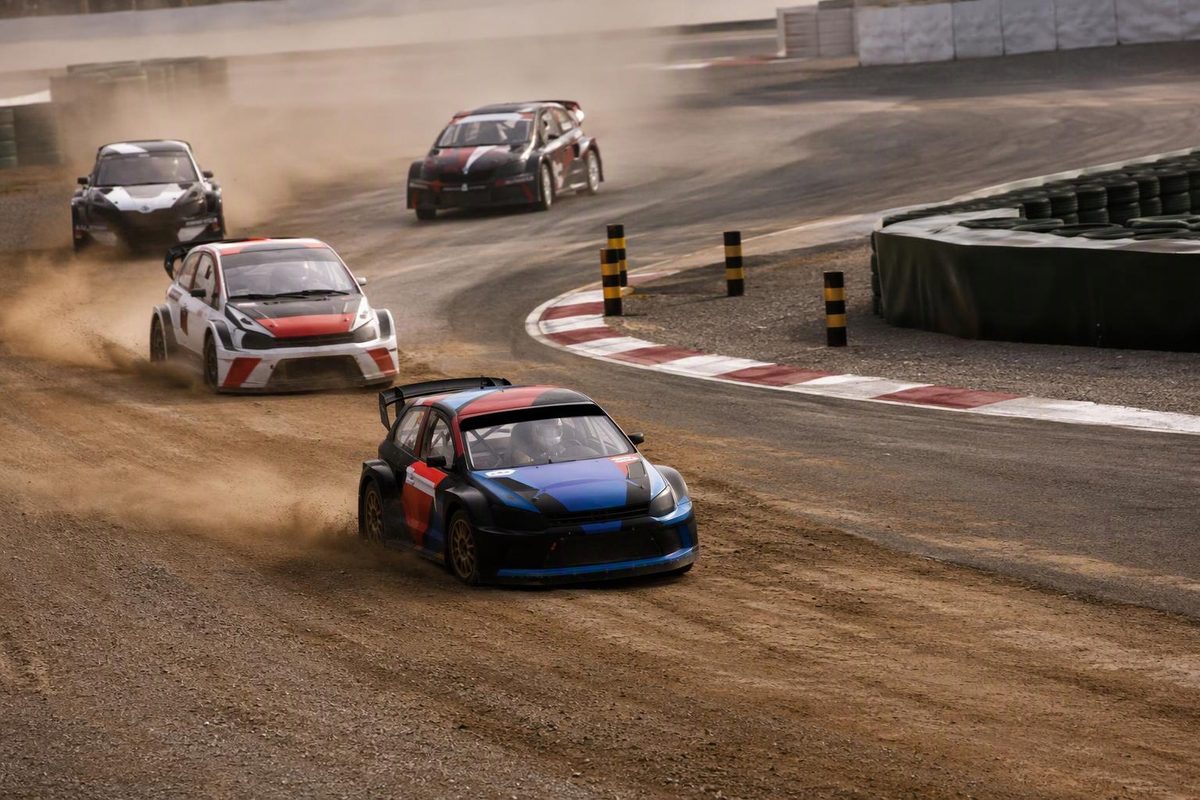
Rallycross is short, wheel-to-wheel circuit racing on a mixture of paved and loose surfaces. Several cars race together, with qualifying heats leading into knockout races and a final. The distinctive strategic feature is the joker lap: an alternative route that drivers must use as required by the event’s rules. Motorsport UK’s introduction describes the discipline’s mixed dirt-and-tarmac racing.
There is no single format covering everything called rallycross. The explanation below uses the 2026 FIA European Rallycross Championship, or Euro RX, under the regulations updated on 15 August 2026. SCCA RallyCross in the United States is a different, individually timed competition.
How a rallycross event works
A Euro RX competition is not one long race. Drivers contest four qualifying rounds, then progress through the knockout stages if they qualify. The scheduled distances and progression are set out in Articles 6 and 34 of the 2026 FIA regulations.
| Stage | Scheduled laps per race | Cars per race | What determines progression? |
|---|---|---|---|
| Qualifying: Q1–Q4 | 4 | Up to 5, starting side by side | Combined qualifying ranking points |
| Four quarter-finals, when held | 5 | Up to 6 | Top three in each race advance |
| Two semi-finals, when held | 6 | Up to 6 | Top three in each race advance |
| Final | 6 | Up to 6 | Final winner wins the competition |
Qualifying measures total race time, not just finishing position within one heat. Each round ranks drivers by their race times and awards ranking points: 50 for fastest, 45 for second, 42 for third, 40 for fourth, then 39, 38 and so on. Those points are added across the four rounds. Winning your own heat therefore does not necessarily make you fastest in that qualifying round.
The top 24 in the qualifying ranking can enter the quarter-finals, provided they have started at least two qualifying sessions. However, quarter-finals require at least 16 cars able to participate. If that threshold is not met, the top 12 go directly to the semi-finals. Semi-finals also have a minimum participation threshold: eight cars. If neither knockout stage is held, the top six in qualifying go directly to the final. These provisions explain why two events can show different knockout schedules under the same rulebook. FIA Articles 34.1–34.5
What is the joker lap?
The FIA defines the joker as an alternative route that is longer in distance and/or time than the main route. It is part of a scheduled lap, not an extra lap added to the race distance.
In 2026 Euro RX, drivers normally take it once in each qualifying, quarter-final, semi-final and final race. A driver who finishes a full-distance race without taking the required joker receives a 30-second time penalty. A false start requires the offending driver to pass through the joker section twice in that race; two false starts in the same race bring a black flag. FIA Articles 2.16, 32.4 and 33.1
A race stopped early by a red flag can instead be classified with a calculated notional joker time added for drivers who have not yet taken it. That is distinct from the 30-second penalty for omitting the joker in a completed race. FIA Article 33.2.4
The timing matters because a leader who has not yet taken the joker still has time to lose relative to a rival who has completed it.
Illustrative example—not measured circuit data: suppose the joker costs three seconds, and Driver A leads Driver B by two seconds. B has already taken it; A has not. With otherwise equal pace and no traffic effects, A would emerge about one second behind after taking the joker. The visible lead is not the same as the lead after both drivers have fulfilled the requirement.
Do not apply the one-joker rule universally. The 2026 FIA Rallycross World Cup appendix requires two joker laps and says they should not be taken on consecutive laps. FIA World Cup appendix, Article 34.1.1
Ranking points are not championship points
Euro RX qualifying points determine advancement and grid allocation; they are not added directly to the season standings. Championship points come from the knockout races:
- Quarter-final: 6, 5, 4, 3, 2, 1.
- Semi-final: 12, 10, 8, 6, 4, 2.
- Final: 22, 15, 12, 9, 6, 3.
The figures run from first through sixth place. Points are awarded only to competitors eligible and registered for the championship; non-registered competitors neither score nor deprive eligible competitors of points. FIA Articles 3.1–3.2
An eligible driver winning all three knockout stages scores 6 + 12 + 22 = 40 championship points. If no quarter-finals are held, no quarter-final points are awarded, so winning the semi-final and final yields 34, not 40. If neither quarter-finals nor semi-finals are held, a final win yields 22. FIA Articles 3.2 and 34.3–34.4
Which cars race—and which “RallyCross” are you watching?
Euro RX is not exclusively four-wheel-drive racing. Its 2026 classes include RX1 four-wheel-drive touring cars, RX3 front-wheel-drive touring cars, RX4 front-wheel-drive Rally4-based cars, and RX5 Cross Car off-road single-seaters. Results and points must therefore be read by category. FIA Article 8 and Euro RX appendix
In SCCA RallyCross, drivers instead negotiate a dirt or grass course marked by cones one at a time. The winner is determined by the lowest cumulative time across the runs, rather than a wheel-to-wheel final. That distinction matters when comparing results: a Euro RX heat time helps build a qualifying ranking, while an SCCA run contributes to an accumulated timed score. SCCA’s explanation of the distinction