
Which Bahrain Lap Record Matches The Time You Need
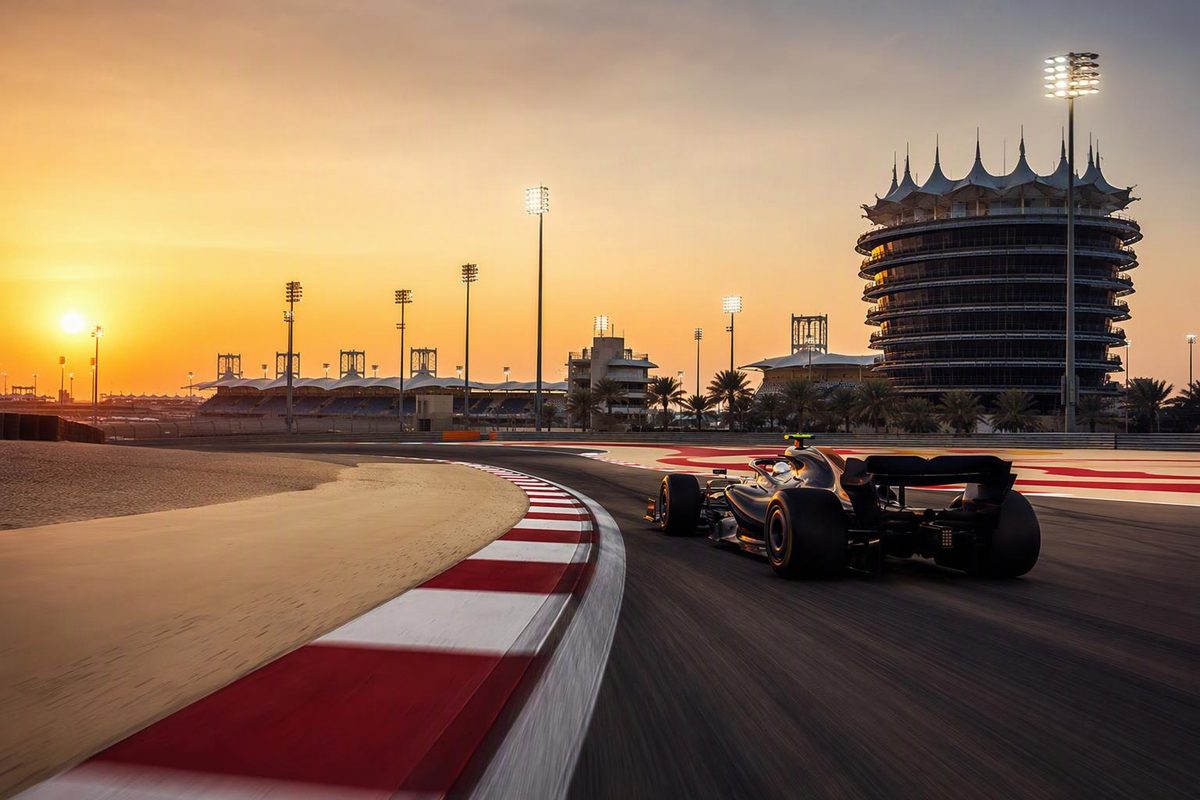
Compare Bahrain’s official race lap record with Hamilton’s qualifying benchmark, plus the separate Sakhir Outer Track times and earlier layout changes.
Bahrain’s official F1 race lap record is Pedro de la Rosa’s 1:31.447, set for McLaren-Mercedes in 2005. Formula 1’s circuit reference lists that time for Bahrain International Circuit’s 5.412 km Grand Prix layout in Sakhir. Lewis Hamilton’s faster 1:27.264 from 2020 is the qualifying benchmark on that layout, not its official race lap record.
The distinction is between sessions, not between competing accounts of the same result. For the usual Bahrain Grand Prix course, use de la Rosa when you need the official race record and Hamilton when you need the qualifying benchmark. For the shorter Outer Track used at the 2020 Sakhir Grand Prix, neither is the applicable time.
Choose the layout and session; the tool shows the matching Bahrain benchmark.
Bahrain Benchmark Selector
Grand Prix layout · Official race lap record
1:31.447
Pedro de la Rosa · McLaren-Mercedes
2005 Bahrain GP · Lap 43
Qualifying laps do not replace this race record.
| Layout | Session | Time | Driver |
|---|---|---|---|
| Grand Prix | Race | 1:31.447 | De la Rosa |
| Grand Prix | Qualifying | 1:27.264 | Hamilton |
| Outer | Race | 0:55.404 | Russell |
| Outer | Qualifying | 0:53.377 | Bottas |
Record Details And Scope
Grand Prix race: Pedro de la Rosa, McLaren-Mercedes, 2005 Bahrain GP, lap 43. Grand Prix qualifying: Lewis Hamilton, Mercedes, 2020 Bahrain GP, Q3.
Outer Track race: George Russell, Mercedes, 2020 Sakhir GP, lap 80. Outer Track qualifying: Valtteri Bottas, Mercedes, 2020 Sakhir GP, Q3.
These are F1 benchmarks for the stated layouts. Schumacher’s 2004 lap belongs to the original configuration. The 2010 Endurance-layout benchmark is not supplied here.
Sources: Formula 1 circuit reference, official 2005 Bahrain and 2020 Sakhir fastest-lap results, 2020 Bahrain qualifying results, and Sakhir qualifying report; layout lengths as documented in the article.
The Four Bahrain Benchmarks Belong To Two Layouts
The main Grand Prix layout and the Outer Track have separate race and qualifying benchmarks. Keeping the layout attached to the time prevents the sub-minute Sakhir laps from being mistaken for records on the usual Bahrain GP course.
| Layout | Session | Time | Driver |
|---|---|---|---|
| Grand Prix, 5.412 km | Race record | 1:31.447 | Pedro de la Rosa |
| Grand Prix, 5.412 km | Qualifying | 1:27.264 | Lewis Hamilton |
| Outer, 3.543 km | Race record | 0:55.404 | George Russell |
| Outer, 3.543 km | Qualifying | 0:53.377 | Valtteri Bottas |
De la Rosa’s time appears in the official 2005 Bahrain fastest-lap results, credited to McLaren-Mercedes on lap 43. Hamilton’s Mercedes time appears in the official 2020 Bahrain qualifying results, in Q3.
For the Outer Track, the official 2020 Sakhir fastest-lap results credit Russell’s Mercedes with 0:55.404 on lap 80. Bottas’s Mercedes qualifying benchmark of 0:53.377 came in Q3, as recorded in Formula 1’s Sakhir qualifying report.
These are F1 benchmarks. They are not a combined ranking of every racing category to have used Bahrain International Circuit. A lap from different machinery needs its own category label, even when it uses the same layout. Without that label, “Bahrain lap record” leaves out part of the comparison.
Hamilton’s Faster Qualifying Lap Does Not Replace The Race Record
Hamilton’s 1:27.264 is quicker than de la Rosa’s 1:31.447, but Formula 1’s published Bahrain lap record is a race-lap benchmark. A qualifying result does not replace it simply because its elapsed time is lower.
Expressed in seconds, Hamilton’s lap took 87.264 seconds and de la Rosa’s took 91.447 seconds. Subtracting Hamilton’s time from de la Rosa’s gives a calculated difference of 4.183 seconds. That is a valid comparison of the recorded durations; it is not a race-record improvement, because the laps belong to different session categories and eras.
The wording around a result therefore matters. “Hamilton’s Bahrain qualifying benchmark” accurately identifies the faster lap. “Hamilton’s official Bahrain race lap record” does not. Likewise, de la Rosa’s record does not mean that no F1 driver has ever completed the Grand Prix layout more quickly in another session.
A race-record page and a qualifying-results page answer different questions. The former identifies the benchmark under the circuit’s race-record convention. The latter records performance during qualifying at a particular event. Both can be correct without displaying the same driver or time.
The stopwatch alone also cannot establish why the qualifying lap was faster. These results do not isolate the effects of the car, tyres, fuel load, track conditions or regulations. The defensible conclusion from the supplied figures is the measured gap and the different session labels—not an estimate of how much each factor contributed.
De La Rosa Set The Race Record On Lap 43 In 2005
De la Rosa recorded 1:31.447 on 3 April 2005, during lap 43 of the Bahrain Grand Prix. The official fastest-lap table gives an average speed of 213.054 km/h for that lap.
That speed is a lap average, not a peak-speed measurement. It describes the completed lap as a whole, including its slower and faster sections. It should not be presented as his maximum speed on a straight or as a speed-trap reading; those would require different timing data.
His car was the McLaren MP4-20, identified in the Motor Sport race database. The team appears as McLaren-Mercedes in the official results. Keeping both descriptions is useful: one identifies the car model, while the other matches the team attribution in the timing table.
This was a substitute appearance rather than a full-season race drive. In McLaren’s account of the race, de la Rosa recalls replacing the injured Juan Pablo Montoya, finishing fifth and setting fastest lap.
His finishing position and lap record describe different parts of the result. Fifth place concerns the race classification; fastest lap concerns one completed circuit. A driver does not need to win the race to set its quickest lap or establish a circuit race record.
For a reference entry, the complete identification is therefore de la Rosa, McLaren-Mercedes, 1:31.447, lap 43, 2005 Bahrain Grand Prix, Grand Prix layout. Removing the event or layout makes the entry less useful, particularly at a venue where F1 has raced on more than one configuration.
An Event’s Fastest Lap Is Not Automatically A Circuit Record
The fastest lap of a Bahrain Grand Prix is the quickest recorded lap in that individual race. The circuit race record is the benchmark against which eligible race laps on the applicable configuration are compared.
An event can have a fastest-lap holder without producing a new circuit record. Its quickest lap might still take longer than 1:31.447. Conversely, de la Rosa’s 2005 result serves both roles: it was that race’s fastest lap and is the race record listed by Formula 1 for the Grand Prix layout.
This distinction explains why looking up a recent Bahrain race’s fastest-lap table is not enough to identify the all-time record. That table establishes the result for the selected event. It does not, by itself, establish whether the time improved the circuit benchmark or whether the event used the same configuration.
The lap number is useful supporting information, but it is not the category. “Lap 43” locates de la Rosa’s performance within the race. “Race record” explains why it belongs in the circuit reference. Hamilton’s Q3 label performs a different function: it places his benchmark within qualifying rather than the Grand Prix itself.
A clear record entry retains both the time and the context. A bare 1:31.447 is less informative than “Grand Prix-layout F1 race record, 1:31.447,” particularly when it appears beside a quicker qualifying time.
Schumacher’s 2004 Time Belongs To The Original Configuration
Michael Schumacher’s 1:30.252 in 2004 is not a replacement for de la Rosa’s record on the later configuration. The official 2004 Bahrain fastest-lap results record Schumacher’s Ferrari time on lap seven. It is numerically quicker than 1:31.447, but the configuration changed between those races.
Turn 4 was realigned between the 2004 and 2005 events. Red Bull’s circuit explanation describes the kerb changes and a roughly five-metre reduction in lap length. The change made it a different configuration for record comparison.
The small size of that length change does not make the two records interchangeable. A circuit record is attached to the course driven, not just to the venue’s name. Nor does the roughly five-metre figure provide enough evidence to calculate an adjusted Schumacher lap or attribute the difference between the two times to the modification.
The appropriate treatment is to preserve Schumacher’s result as a race fastest lap on the original configuration. It should not be silently inserted into a table for the later Grand Prix layout merely because the event was also called the Bahrain Grand Prix.
This is the reason a historical results search can produce an apparently contradictory answer. The 2004 timing table is not wrong, and the circuit reference listing de la Rosa is not contradicted by it. They describe laps on configurations that need separate labels.
The Sakhir Outer Track Has Its Own Sub-Minute Records
The 2020 Sakhir Grand Prix used the 3.543 km Outer Track, rather than the 5.412 km Grand Prix layout. Russell’s 0:55.404 race record and Bottas’s 0:53.377 qualifying benchmark belong to that shorter course.
Those sub-minute times should not be ranked directly against de la Rosa’s or Hamilton’s laps as evidence of greater performance on the same circuit. The drivers were completing different routes. A lower elapsed time on a shorter layout does not establish a faster lap of the longer layout.
The event names help distinguish the two 2020 results: Hamilton’s benchmark came at the Bahrain Grand Prix, while Russell’s and Bottas’s Outer Track times came at the Sakhir Grand Prix. But names alone are not a reliable substitute for a layout field. Sakhir is also the location of Bahrain International Circuit, so it can appear in descriptions of the ordinary Grand Prix course.
Formula 1 also used the longer Endurance layout for the 2010 Bahrain Grand Prix, another separate comparison described in its Sakhir circuit guide. The record set supplied here does not include an Endurance-layout benchmark, so neither the Grand Prix-layout nor Outer Track time should be used to fill that gap.
That is also why the selector offers only the two layouts with the four benchmarks documented here. It does not imply that Bahrain International Circuit has only those configurations. An unsupported record should remain unspecified rather than be borrowed from another course.
Use The Layout And Session Together In Any Comparison
For the usual interpretation of “Bahrain lap record”—the official F1 race record on the Grand Prix layout—the answer remains Pedro de la Rosa, 1:31.447. For a qualifying comparison on that layout, the benchmark presented here is Lewis Hamilton, 1:27.264.
For the 2020 Outer Track, use George Russell’s 0:55.404 when comparing race laps and Valtteri Bottas’s 0:53.377 when comparing qualifying. Keep Schumacher’s 2004 lap under the original configuration, and keep the 2010 Endurance layout separate from both modern entries.
When a quoted time lacks a layout or session, its meaning is incomplete. Establish those fields before deciding whether it challenges a record. Then check the machinery category: the figures above concern Formula 1, not an unrestricted record across every car that has visited the circuit.
This produces a reference that survives being copied into a results table: driver, time, layout, session and event remain attached. The same need to separate race records from qualifying benchmarks applies to the Le Mans lap record.