
How Four Drivers Reached the Indy 500 Wins Record
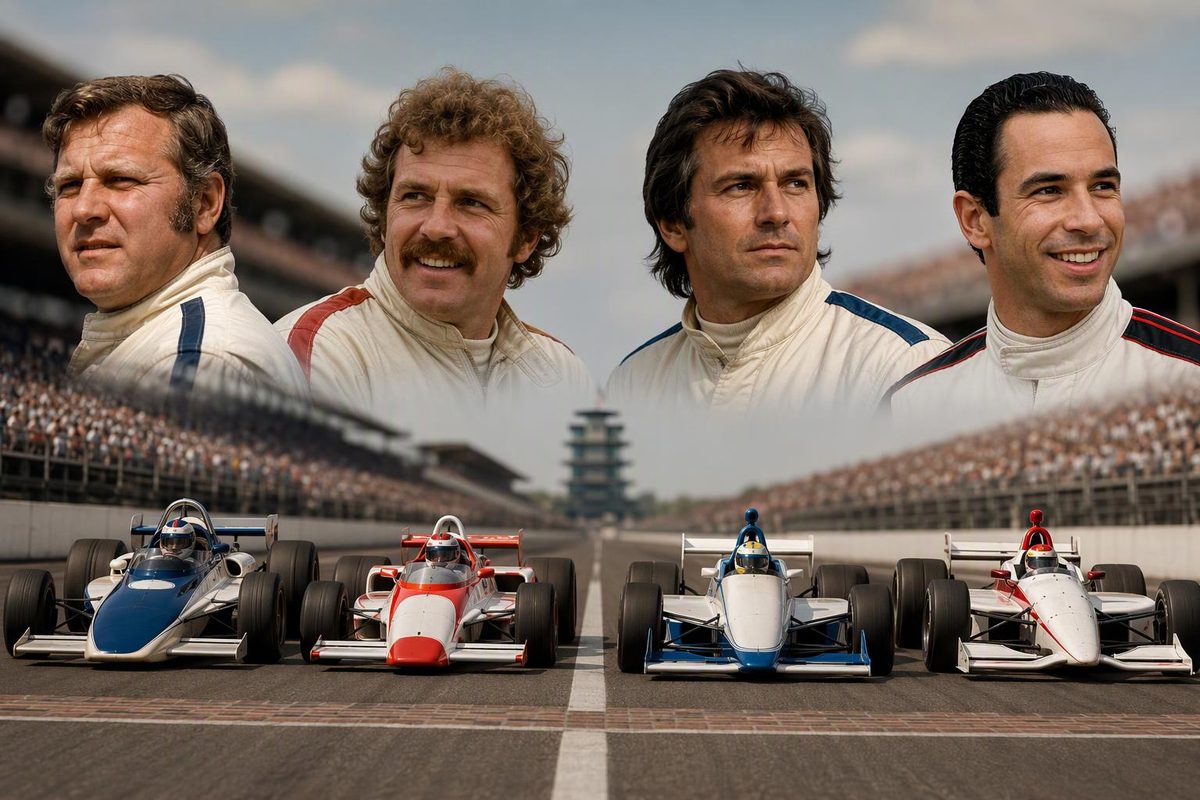
Compare A.J. Foyt, Al Unser, Rick Mears and Hélio Castroneves by winning years, grid positions, record spans and victories from pole at Indianapolis.
Four drivers share the record for the most Indianapolis 500 victories: A.J. Foyt, Al Unser, Rick Mears and Hélio Castroneves. Each has won the race four times, and nobody has reached five.
Choose a comparison measure to see which four-time winner leads it.
Compare the Four Record Holders
| Driver | Winning years | Span | Pole wins |
|---|---|---|---|
| A.J. FoytStarts: 7th, 5th, 4th, 4th | 1961, 1964, 1967, 1977 | 16 years | 0 |
| Al UnserStarts: 1st, 5th, 5th, 20th | 1970, 1971, 1978, 1987 | 17 years | 1 |
| Rick MearsStarts: 1st, 3rd, 1st, 1st | 1979, 1984, 1988, 1991 | 12 years | 3 |
| Hélio CastronevesStarts: 11th, 13th, 1st, 8th | 2001, 2002, 2009, 2021 | 20 years | 1 |
Source: Indianapolis Motor Speedway four-time winner and race-winner records.
The Four-Time Winners and Their Winning Years
The Indianapolis Motor Speedway’s official four-time winners record identifies the four drivers and their victories. Foyt was the first to reach four, Unser followed a decade later, Mears completed the shortest first-to-fourth span, and Castroneves became the fourth member of the group in 2021.
| Driver | Winning years | Span | Winning starts |
|---|---|---|---|
| A.J. Foyt | 1961, 1964, 1967, 1977 | 16 years | 7th, 5th, 4th, 4th |
| Al Unser | 1970, 1971, 1978, 1987 | 17 years | 1st, 5th, 5th, 20th |
| Rick Mears | 1979, 1984, 1988, 1991 | 12 years | 1st, 3rd, 1st, 1st |
| Hélio Castroneves | 2001, 2002, 2009, 2021 | 20 years | 11th, 13th, 1st, 8th |
The grid positions come from the Speedway’s year-by-year Indianapolis 500 winner table. They show that the same total of four victories was assembled in markedly different ways.
Mears converted pole position into three of his four wins. Unser and Castroneves each won once from pole, while none of Foyt’s victories began from the first starting position. Altogether, five of the 16 winning drives started from pole; the other 11 did not.
The range of successful grid positions is also wide. Mears never started a winning race outside the first row, whereas Unser’s fourth victory came from 20th. Foyt’s winning starts all fell between fourth and seventh. Castroneves won from four different positions: 11th, 13th, first and eighth.
Foyt Established the Four-Win Record in 1977
A.J. Foyt became the Indianapolis 500’s first four-time winner in 1977. His victories came in 1961, 1964, 1967 and 1977, giving him a 16-year span between his first and fourth wins.
Foyt did not start any of those four races from pole. He began seventh in 1961, fifth in 1964, and fourth in both 1967 and 1977. Every winning start was therefore seventh or better, but none came from the front row.
The speed difference between the first and fourth victories reflects the historical separation between them. Indianapolis Motor Speedway records a race-average speed of 139.130 mph for Foyt’s 1961 victory and 161.331 mph for his 1977 win. That is a difference of 22.201 mph across the 16-year span. The broader historical series appears in Indy 500 winner average speed by year.
His 1977 result created the four-victory benchmark that every subsequent record holder matched rather than surpassed. Foyt remained the only four-time winner until Unser joined him in 1987.
Unser Combined Consecutive Wins With a Victory From 20th
Al Unser won in 1970 and 1971, becoming the fourth driver to win consecutive Indianapolis 500s. He added his third victory in 1978 and tied Foyt’s record with his fourth in 1987.
The four victories covered 17 years, one year longer than Foyt’s first-to-fourth span. Unser started from pole for the first win, then fifth for the next two. His final victory began from 20th, the deepest grid position among the 16 winning performances by the four record holders.
That 1987 result separates Unser’s record from the qualifying profile of the other three. Mears won only from first or third, Foyt won from fourth through seventh, and Castroneves’ lowest winning start was 13th. Unser alone reached the record with a winning drive that began as far back as the 20th position.
Unser was 47 years and 360 days old when he won in 1987. The Speedway lists him as the oldest winner in Indianapolis 500 history. That fourth victory therefore tied the career-win record while also establishing the race’s winning-age mark.
Mears Reached Four in the Shortest Span
Rick Mears won the Indianapolis 500 in 1979, 1984, 1988 and 1991. The 12 years from his first victory to his fourth represent the shortest span among the four record holders.
Foyt needed 16 years between his first and fourth wins, Unser needed 17, and Castroneves needed 20. Mears’ 12-year route was four years shorter than the next-fastest progression to four.
Qualifying position is the other distinguishing feature of his results. Mears won from pole in 1979, 1988 and 1991. His 1984 victory began from third. Because the Indianapolis front row contains the first three starters, all four of his wins came from the front row.
No other member of the group won more than once from pole. Unser and Castroneves each did it once, while Foyt did not do it. Mears consequently accounts for three of the group’s five victories from the first starting position.
The Speedway also credits Mears with a record six Indianapolis 500 pole positions. He qualified first in 1979, 1982, 1986, 1988, 1989 and 1991. Three of those poles became race victories, while his 1984 win came from third.
Mears joined Foyt and Unser as a four-time winner in 1991. The record then had three holders until Castroneves’ fourth victory 30 years later.
Castroneves Took 20 Years to Complete His Four Wins
Hélio Castroneves won on his first Indianapolis 500 start in 2001 and repeated in 2002. He secured his third victory in 2009, then went 11 editions without another before winning again in 2021.
That fourth victory produced a 20-year interval from his first win, the longest first-to-fourth span in the group. It is three years longer than Unser’s 17-year span, four longer than Foyt’s 16 and eight longer than Mears’ 12.
Castroneves’ winning grid positions were 11th in 2001, 13th in 2002, first in 2009 and eighth in 2021. Unlike Mears, he did not depend on consistently high starting positions: three of his four winning drives began outside the first row. His sole victory from pole was the third win in 2009.
Castroneves beat Alex Palou to win in 2021. IndyCar’s account of the milestone notes that he had moved from Team Penske to Meyer Shank Racing and delivered Meyer Shank Racing’s first Indianapolis 500 victory.
The result made Castroneves the fourth driver to reach the record. It also produced the group’s widest gap between first and fourth wins, in contrast with Mears’ group-low 12-year span.
The Record Developed Across Four Milestone Races
The four-driver list was built through four distinct record-tying or record-setting races:
- Foyt became the first four-time winner in 1977.
- Unser tied Foyt in 1987.
- Mears joined them in 1991.
- Castroneves became the fourth member in 2021.
The chronology matters because “four-time winner” does not describe a record that all four drivers held simultaneously throughout their careers. Foyt established it first. Unser and Mears later matched it, and Castroneves completed the current group three decades after Mears.
Their routes also cover different competitive patterns. Unser was the only one of the four to include consecutive victories in his set and the only one to win from 20th. Mears had the shortest span and the strongest pole-conversion record. Castroneves had the longest span and opened with victories in his first two appearances. Foyt set the benchmark without winning any of his four from pole.
The common element is the final total, not the manner in which it was achieved. Across the 16 victories, winning starts extend from pole to 20th, while first-to-fourth spans range from 12 to 20 years.
Nobody Has Won the Indianapolis 500 Five Times
Four remained the individual Indianapolis 500 record after the 2026 race. The Speedway’s official winners table lists Marcus Ericsson as the 2022 winner, Josef Newgarden in 2023 and 2024, Alex Palou in 2025 and Felix Rosenqvist in 2026. None of those results changed the four-way tie at the top.
Castroneves, the most recent driver to reach four, finished 25th in the official 2026 Indianapolis 500 results. He therefore remained tied with Foyt, Unser and Mears rather than becoming the first five-time winner.
The first three record holders also continued trying after earning their fourth victories. IndyCar records that Foyt made 15 further attempts to win a fifth, Unser made five and Mears made one. None succeeded.
Those attempts underline the distinction between reaching the record and taking sole possession of it. Each driver’s fourth victory placed him alongside the existing leader or leaders. A fifth would have broken the tie, but the official winners list still contains no five-time champion.
Shortened Races Still Count as Indianapolis 500 Wins
The modern Indianapolis 500 is scheduled for 200 laps of the 2.5-mile Indianapolis Motor Speedway oval. Multiplying the lap count by the track length gives the nominal 500-mile race distance.
The career record counts official race victories, including editions shortened by weather or other circumstances. It does not require each winning event to have completed the scheduled 200 laps. The distance calculation and historical exceptions are covered in Indy 500 track length, lap count and race distance.
That definition keeps the comparison tied to official Indianapolis 500 results. Foyt, Unser, Mears and Castroneves each appear four times as the race winner, which is the basis for the shared record.