
How 2.5 Miles Becomes the Indianapolis 500
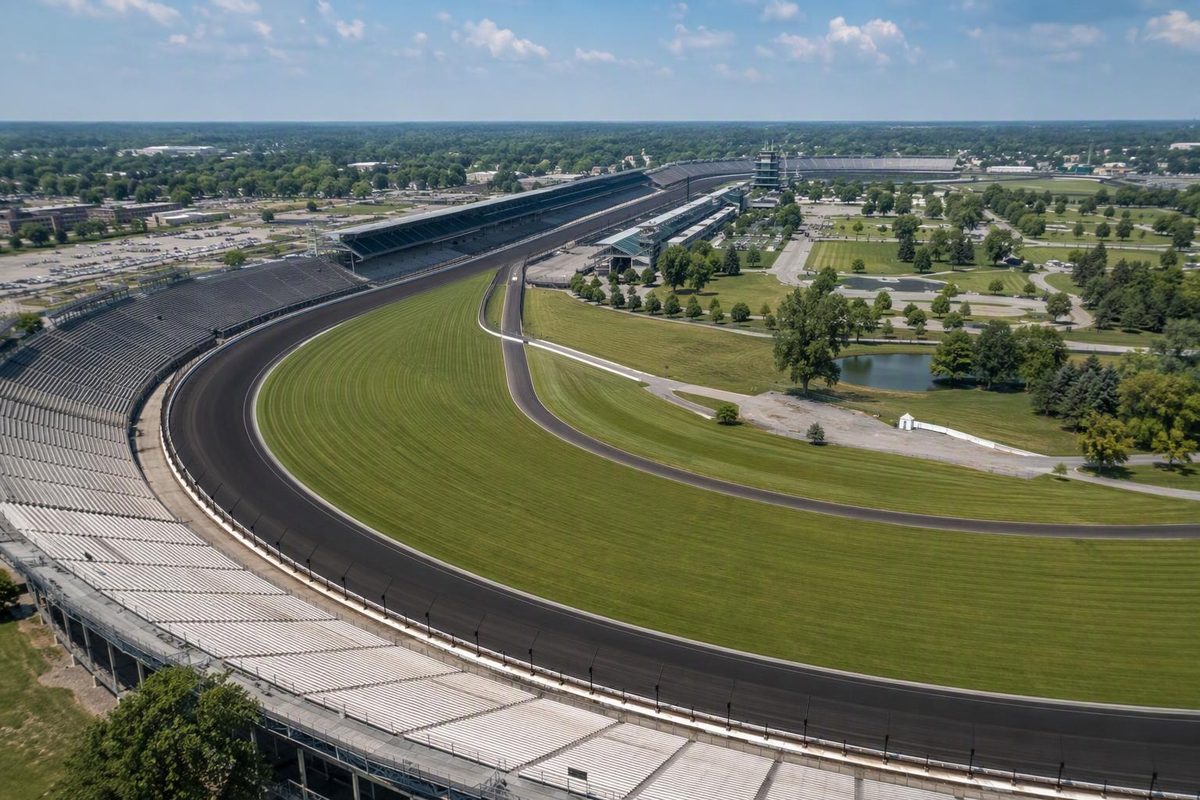
See the Indianapolis Motor Speedway oval’s lap length in miles and kilometres, plus the 200-lap calculation, halfway mark and track dimensions.
The Indy 500 track is 2.5 miles (4.023 km, rounded) per lap. The Indianapolis 500 is scheduled for 200 laps, so its full race distance is 500 miles (804.672 km). The “500” refers to miles, not the number of laps.
INDYCAR’s official 2026 event page lists the same three figures: a 2.5-mile track, 200 scheduled laps and a 500-mile race distance (INDYCAR).
Enter a lap count or distance to see the equivalent point in the 500-mile race.
Indy 500 Lap And Distance Converter
Equivalent Race Point
200 laps is the full scheduled distance
Calculation And Limits
The converter uses 2.5 miles per lap and 804.672 km for the scheduled 200-lap race. It accepts decimals and covers values from zero through the full scheduled distance.
The displayed one-lap metric reference of 4.023 km is rounded; calculations use 4.02336 km per lap to preserve the stated full-race distance.
Source: INDYCAR 2026 Indianapolis 500 event figures—2.5 miles, 200 laps and 500 miles.
One Indy 500 Lap Is 2.5 Miles
The essential Indy 500 distance figures are:
| Measure | Miles | Kilometres |
|---|---|---|
| One lap | 2.5 | 4.023 |
| 100 laps—half distance | 250 | 402.336 |
| 200 laps—full distance | 500 | 804.672 |
The race-distance arithmetic is direct: 2.5 miles per lap × 200 laps = 500 miles.
The kilometre figure for one lap is normally displayed as 4.023 km because it has been rounded to three decimal places. Using the full-race metric distance, one lap works out to 4.02336 km: 804.672 km divided by 200 laps.
That distinction matters when calculating the entire race. Multiplying the rounded 4.023 km figure by 200 gives 804.6 km, not 804.672 km. The 72-metre difference comes from rounding each lap before multiplication. For the published full-race distance, use 804.672 km; for a compact one-lap reference, 4.023 km is the rounded value.
The mile calculation does not have that issue because the oval’s stated length is exactly 2.5 miles at the precision used for the race distance. Every two laps add 5 miles, every four laps add 10 miles, and every 40 laps add 100 miles.
The Indy 500 Uses the Speedway’s Oval
“Indianapolis Motor Speedway” can mean the complete racing facility, which also contains an infield road course. The Indianapolis 500 uses the historic 2.5-mile oval, not the road-course configuration.
That configuration distinction is necessary when interpreting any track-length figure associated with Indianapolis. The relevant number for an Indy 500 lap is always the oval’s 2.5 miles. A distance attached to another Indianapolis Motor Speedway configuration does not change the oval distance or the 200-lap calculation for the 500.
The oval is often described as rectangular because it has four distinct corners. Two long straightaways run along the principal sides of the circuit, while two short chutes separate Turns 1 and 2 and Turns 3 and 4. The corners therefore do not form the two long, continuous bends commonly associated with a simpler oval outline.
An Indy 500 lap means one complete circuit of this oval. Crossing the start-finish line after traveling around all four turns, both main straightaways and both short chutes adds 2.5 miles to the race total. After 200 such circuits, the scheduled distance reaches 500 miles.
The Straights, Chutes and Turns Add Up to 2.5 Miles
The Indianapolis Motor Speedway oval has two long straightaways of 5/8 mile each, two short chutes of 1/8 mile each and four turns. Each turn is banked at 9 degrees, 12 minutes, while the straightaways are unbanked. IMS says these dimensions have remained unchanged since the circuit opened in 1909 (Indianapolis Motor Speedway).
The named sections account for the lap in a few steps:
- Two main straightaways: 2 × 0.625 = 1.25 miles
- Two short chutes: 2 × 0.125 = 0.25 miles
- Four turns combined: 1 mile
- Complete oval: 2.5 miles
The straightaways and short chutes therefore account for 1.5 miles of the lap. Subtracting that from the complete 2.5-mile length leaves 1 mile for the four turns combined.
This breakdown also shows why looking only at the two prominent straightaways understates the track length. Together, those straights make up 1.25 miles, exactly half of the complete lap. The other half consists of the short chutes and turns.
The two short chutes total 0.25 mile. Adding them to the long straightaways gives 1.5 miles of straight or chute sections in the dimensional breakdown. The remaining mile is assigned to the corners collectively.
The banking figure applies to each of the four turns rather than to the straightaways. It is written as 9 degrees, 12 minutes, where “minutes” is part of the angular measurement. It is not a reference to elapsed lap time or race time.
These dimensions describe the oval used for the Indianapolis 500. They should not be combined with measurements from the facility’s road course, because that would mix two different configurations.
The “500” Means Miles, Not Laps
The race name identifies its scheduled distance in miles. A full Indianapolis 500 is 500 miles, completed through 200 laps of a 2.5-mile track.
The calculation can also be reversed: 500 miles ÷ 2.5 miles per lap = 200 laps. This is why neither 500 laps nor a 500-kilometre distance is implied by the race name.
At Lap 100, a car has completed 250 miles, which is half of the scheduled 500-mile distance. IMS also identifies Lap 100 as halfway in its historical analysis of halfway leaders (Indianapolis Motor Speedway).
The halfway relationship can be confirmed in either direction. Multiplying 100 laps by 2.5 miles gives 250 miles. Dividing the 500-mile race distance by two produces the same 250-mile point.
In kilometres, the halfway distance is 402.336 km. Doubling it gives the complete 804.672 km metric distance. This preserves the full precision of the stated race conversion rather than relying on the rounded 4.023 km one-lap display.
Common Lap Counts Convert Directly to Miles
Because each circuit is 2.5 miles, converting laps to miles requires only multiplication by 2.5. These benchmarks cover several useful points in the scheduled race:
| Laps | Miles | Race Completed |
|---|---|---|
| 10 | 25 | 5% |
| 40 | 100 | 20% |
| 80 | 200 | 40% |
| 100 | 250 | 50% |
| 160 | 400 | 80% |
| 200 | 500 | 100% |
For example, 80 laps represent 200 miles because 80 × 2.5 = 200. At 160 laps, the accumulated distance is 400 miles. The final 40 laps then add the remaining 100 miles.
The reverse conversion is miles divided by 2.5. A 100-mile segment equals 40 laps, while a 25-mile segment equals 10 laps. Since 2.5 is half of 5, another quick method is to multiply the lap count by five and divide by two.
Percentage of the scheduled race can be calculated without converting to miles. Divide completed laps by 200 and multiply by 100. Lap 40 is 20% because 40 divided by 200 is 0.20. Lap 160 is 80% by the same method.
Miles produce the same percentages because the lap length is fixed. A 100-mile point is 20% of 500 miles, and a 400-mile point is 80%. The lap, mile and percentage columns are three expressions of the same race progress.
For kilometre calculations, using the complete metric distance avoids accumulated rounding. Multiply the fraction of 200 laps completed by 804.672 km. At 100 laps, the fraction is one-half, producing 402.336 km.
Scheduled Distance Is Different From a Progress Reading
The 500-mile figure states the scheduled length of the race. A lap counter, by contrast, identifies a position within that schedule. “Lap 100,” “100 laps completed” and “250 miles completed” need to be interpreted carefully when reading timing information, but the underlying distance relationship remains 2.5 miles for each completed circuit.
For a distance after a stated number of completed laps, multiply that count by 2.5 miles. Zero completed laps corresponds to zero race miles, 100 completed laps corresponds to 250 miles, and 200 completed laps corresponds to the scheduled 500 miles.
A displayed current lap can follow timing conventions that distinguish the lap being run from laps already completed. The track-length calculation itself does not resolve that wording. It converts a known count of completed laps into distance. The calculator above therefore treats the entered lap figure as completed laps or a lap-equivalent distance.
Decimal values can represent a lap-equivalent point for calculation even though official race totals are normally discussed in complete laps. Half a lap is 1.25 miles, for example, because 0.5 × 2.5 = 1.25. Such a value is a distance conversion, not a claim that the official classification records that fraction as a completed lap.
The 2.5-Mile Length Dates to the Speedway’s Construction
The oval’s length comes from the original design of Indianapolis Motor Speedway. According to the Speedway’s history, engineer P.T. Andrews recommended a 2.5-mile circuit because a proposed 3-mile outer circuit would have left inadequate room for grandstands on the available property (Indianapolis Motor Speedway).
That design choice established the arithmetic still associated with the Indianapolis 500: 200 laps at 2.5 miles per lap. It also produced the clear halfway marker at 100 laps and 250 miles.
The track length is therefore not a distance inferred from the race’s name. The relationship runs in the other direction: the oval is 2.5 miles long, and 200 laps of it produce the 500-mile scheduled distance reflected in the name.
For comparisons of how quickly winners have covered that distance in different editions, see the Indianapolis 500 winner average speed by year.