
Hamilton Holds Singapore’s Race Record, Russell Its Qualifying Benchmark
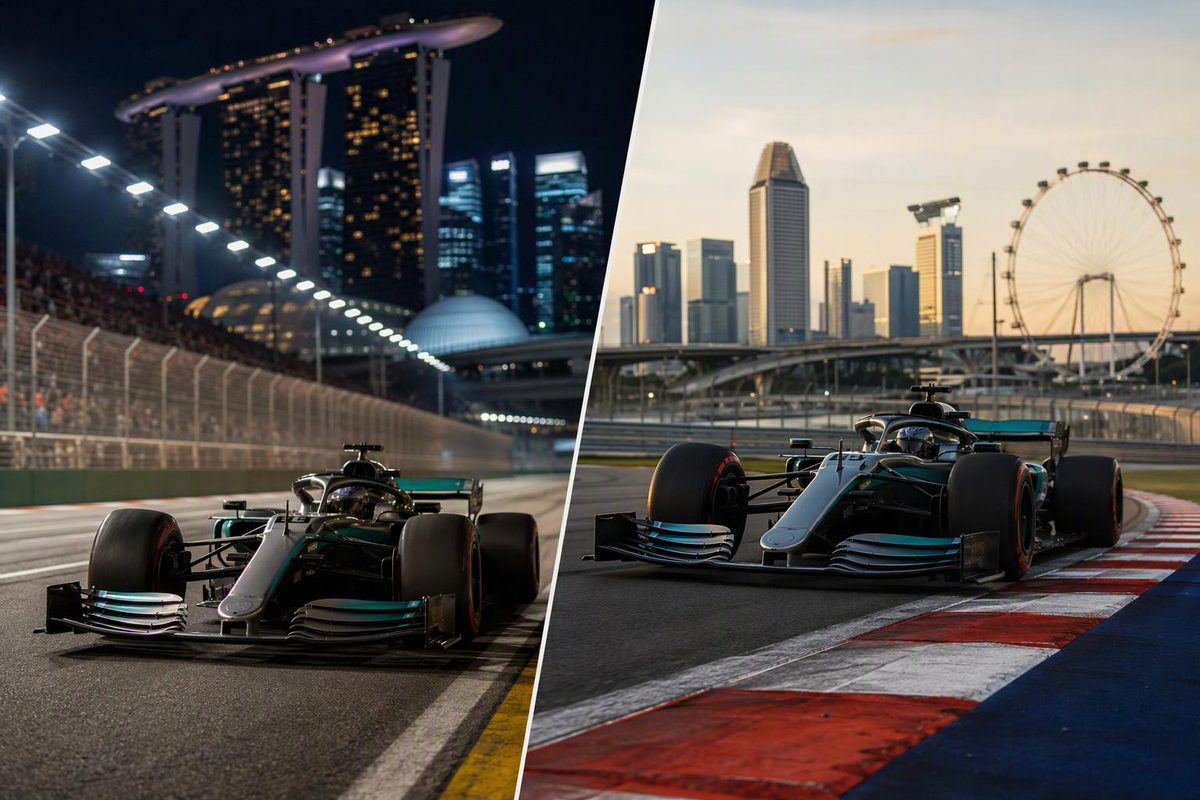
Compare Hamilton’s 1:33.808 race record with Russell’s 1:29.158 qualifying lap, and see why older Marina Bay times need a separate circuit-layout label.
The Singapore GP race lap record is 1:33.808, set by Lewis Hamilton for Ferrari on lap 48 of the 2025 race. The faster qualifying benchmark is 1:29.158, set by George Russell for Mercedes in 2025. They answer different questions: Hamilton holds the race record; Russell set the qualifying track benchmark. Formula 1’s official race timing and qualifying results establish the two times.
Choose the record category; the tool identifies the time, driver and comparison that applies.
Choose A Singapore Lap Benchmark
Current race record
1:33.808
Lewis Hamilton · Ferrari · 2025
Set on lap 48. It beat Ricciardo’s previous race record by 0.678 seconds.
| Category | Time | Driver | Year |
|---|---|---|---|
| Race | 1:33.808 | Hamilton | 2025 |
| Qualifying | 1:29.158 | Russell | 2025 |
| Previous race | 1:34.486 | Ricciardo | 2024 |
| Older layout | 1:41.905 | Magnussen | 2018 |
Session And Layout Caveats
Current race: Hamilton’s Ferrari lap is the race record listed for the current circuit, which F1 gives as 4.927 km.
Qualifying: Russell’s Mercedes pole lap is 4.650 seconds faster than the race record. This compares different sessions, not equivalent conditions.
Previous race: Ricciardo’s RB lap was the standing race benchmark entering the 2025 weekend.
Older layout: Magnussen’s Haas lap belongs to the 5.063 km, 23-corner circuit. The major 2023 change reduced the corner count to 19; do not treat the old and current records as laps of the same course.
Sources: F1 2025 race timing, 2025 qualifying, 2024 race timing and 2018 circuit record; benchmarks before the 2026 event.
The Four Singapore Benchmarks To Keep Separate
| Benchmark | Lap Time | Driver / Team | Year |
|---|---|---|---|
| Current race record | 1:33.808 | Hamilton / Ferrari | 2025 |
| Qualifying benchmark | 1:29.158 | Russell / Mercedes | 2025 |
| Previous race record | 1:34.486 | Ricciardo / RB | 2024 |
| Older-layout race record | 1:41.905 | Magnussen / Haas | 2018 |
Hamilton’s time is the answer when “Singapore GP lap record” means the fastest race lap recognised for the current circuit. Formula 1’s 2026 Singapore circuit page and the event promoter’s fast facts both list his 2025 mark as the lap record.
Russell’s time belongs alongside it, not in place of it. Formula 1 described his pole-position performance as a new track record. That wording refers to the faster qualifying benchmark, whereas the circuit page’s lap-record field gives the race mark.
The other two entries explain why older references can show different answers. Daniel Ricciardo’s 2024 lap was the race record before Hamilton improved it. Kevin Magnussen’s 2018 lap is a historical race record for the longer Marina Bay configuration. Neither is the current race-record answer, but neither should be discarded as an erroneous time.
A useful reference entry therefore needs more than a driver and a stopwatch reading. It needs the session category, the year and, where the circuit has changed, the layout. Without those labels, all four times can appear to compete for the same record even though they describe different benchmarks.
Hamilton’s 1:33.808 Is A Race Lap, Not A Race Time
Hamilton recorded 1:33.808 on lap 48 of the 2025 Singapore Grand Prix. That is the duration of one lap during the race. It is not his total race time, a qualifying result or an average across the Grand Prix.
The team label is Ferrari because the record was set in 2025 with Ferrari. A lap-record entry should identify the team attached to the performance, rather than substitute a team associated with another part of the driver’s career. The same principle applies to Ricciardo’s RB entry and Magnussen’s Haas entry in the comparison table.
The race timing establishes who set the lap, how fast it was and where it occurred in the race. The circuit page and promoter’s record listing establish its status as the current race benchmark. Those are related pieces of evidence, but they do different jobs: an event result documents a performance; a circuit-record listing identifies the standing mark.
Being fastest in a particular Grand Prix does not, by itself, make a lap a circuit record. A race-winning fastest-lap entry must also beat the existing race benchmark to replace it. Hamilton’s lap did that: it was 0.678 seconds quicker than Ricciardo’s previous record of 1:34.486.
The supplied timing evidence does not give a complete tyre, fuel or track-condition comparison between those two laps. The record improvement is established by the times; its causes are not established by the record table alone. A precise lap-time difference should not be presented as a precise measurement of car development or driver performance under matched conditions.
Russell’s 1:29.158 Answers The Qualifying Question
Russell’s 1:29.158 was the pole-position lap in 2025. It is the appropriate answer for someone asking for Singapore’s qualifying record or the faster F1 track benchmark identified in Formula 1’s report.
It does not replace Hamilton’s race record because it was set in a different session. The distinction is not a technicality added to protect the slower time. It is the definition of the comparison: a record restricted to Grand Prix race laps excludes qualifying laps, however fast those qualifying laps are.
This also explains why the phrase “track record” needs context. In the 2025 qualifying report, Formula 1 used it for Russell’s new benchmark. On the circuit information page, the lap-record field lists Hamilton’s race lap. Read without the session label, those two official references can seem inconsistent. Read with it, they are compatible.
Russell’s qualifying lap took 89.158 seconds, while Hamilton’s race record took 93.808 seconds. The difference is 4.650 seconds. That is the gap between the two session benchmarks, not a head-to-head margin between Russell and Hamilton in an equivalent timed test.
For a results table, the clearest labels are “race lap record” for Hamilton and “qualifying benchmark” for Russell. If using “outright F1 track benchmark” for Russell, retain the qualifying context. The cited evidence concerns Formula 1 at Marina Bay; it does not establish a record covering every vehicle, racing category or possible use of the venue.
A reader looking for the fastest of these two documented laps should choose Russell’s time. A reader filling the conventional race-lap-record field should choose Hamilton’s. Reporting both, with their categories intact, is more accurate than trying to force one number to answer both requests.
Ricciardo’s 2024 Record Was Superseded, Not Misreported
Ricciardo set 1:34.486 for RB in 2024, as shown in Formula 1’s 2024 Singapore fastest-lap results. Formula 1’s guide ahead of the 2025 race identifies that time as the record entering the weekend.
That makes a reference giving Ricciardo as the Singapore record-holder potentially accurate for its publication period. The decisive question is whether it describes the record before or after the 2025 race. Hamilton’s new mark superseded the earlier entry; it did not make the earlier event result incorrect.
The comparison between these two records is more direct than a comparison with Magnussen’s 2018 time. Ricciardo and Hamilton set their marks after the major 2023 configuration change. Their times belong in the recent race-record sequence, rather than on opposite sides of the old 23-corner and newer 19-corner layouts.
Even so, “same record category” does not mean “same performance conditions.” The 0.678-second improvement establishes the change in the benchmark. It does not isolate how much came from the driver, car, tyres or circumstances of the lap.
When retaining Ricciardo’s time in a reference, label it previous race record. Calling it simply “the lap record” without a historical qualifier would leave the reader with an outdated answer. Calling it merely a fastest lap would lose the useful fact that it was also the standing benchmark entering the next Singapore race.
Magnussen’s Record Belongs To The Longer Layout
Magnussen’s 1:41.905 for Haas in 2018 is associated with the older 5.063 km Marina Bay circuit. Formula 1’s 2018 event page lists that layout and record, while Haas’s account of Magnussen’s Singapore record provides the team’s historical reference.
Marina Bay changed substantially in 2023. The corner count fell from 23 to 19, and the former Turns 16–19 section became a long straight. The current F1 circuit guide dates the change, and the pre-2025 track explanation identifies the removed section.
Formula 1 lists the current circuit length as 4.927 km, rather than the older 5.063 km. Those lengths are part of the record’s identity, not optional background. A lap on the older route and a lap on the current route do not cover the same course.
Magnussen’s slower numerical time therefore cannot be used as a straightforward measure of how much faster Hamilton’s car or driving was. The layout changed as well as the year, driver and car. Subtracting the two stopwatch readings would produce a time difference, but would not separate those influences.
The older record still has a clear use: it answers a historical question about the longer, 23-corner configuration. It is also the right entry when a table explicitly compares records by layout. It is not the right headline answer for the current Singapore race record.
Keep the layout qualifier attached wherever the time is reused. “Magnussen, 1:41.905, 2018” gives a genuine performance but leaves its relevance unclear. “Older 5.063 km layout race record” tells the reader why the entry differs from the current benchmark and why both can remain in a reference table.
Read The Times As Minutes, Seconds And Thousandths
The notation 1:33.808 means one minute followed by 33.808 seconds. The colon separates minutes from seconds; the decimal point separates whole seconds from the fractional part. It is not a decimal-minute value.
For the qualifying-to-race comparison, converting each time to seconds gives 93.808 − 89.158 = 4.650 seconds. For the recent race-record improvement, 1:34.486 minus 1:33.808 gives 0.678 seconds.
Keep the displayed precision when quoting these results. Rounding Hamilton’s mark to a whole second would no longer reproduce the official record. Dropping the final zero from the 4.650-second comparison would leave the arithmetic value unchanged, but retaining it makes the presentation consistent with timing recorded to thousandths.
The precision of the timing should not be confused with the strength of the comparison. The qualifying and race gap can be calculated exactly from the published times, while the explanation for that gap remains outside what those two entries establish. Likewise, the old-layout and current-layout records are precisely timed but are not interchangeable course measurements.
Use The Record That Matches The Question And Date
For the current Singapore GP race lap record, use Lewis Hamilton, Ferrari, 1:33.808, 2025. For the qualifying benchmark, use George Russell, Mercedes, 1:29.158, 2025. For the record entering the 2025 event, use Ricciardo’s 2024 time; for the older 5.063 km layout, use Magnussen’s 2018 mark.
These are the standing references as of 8 October 2026, before the scheduled 9–11 October 2026 Singapore Grand Prix weekend. That timing matters because a circuit page for the upcoming event can still correctly display a record from the previous year. The year in the page address is not necessarily the year in which its lap record was set.
A subsequent qualifying performance and a subsequent race performance must be checked separately. A new qualifying benchmark would not automatically change the race-record entry, and the fastest lap of a later race would replace Hamilton’s mark only if it beat 1:33.808. The cited pre-weekend records do not establish what happens during the upcoming event.
The same session-and-layout distinction applies when comparing the Bahrain race, qualifying and Sakhir lap records: the useful number is the one attached to the course and session the reader actually means.