
The Nürburgring Nordschleife record is 5:19.546—not the production-car record
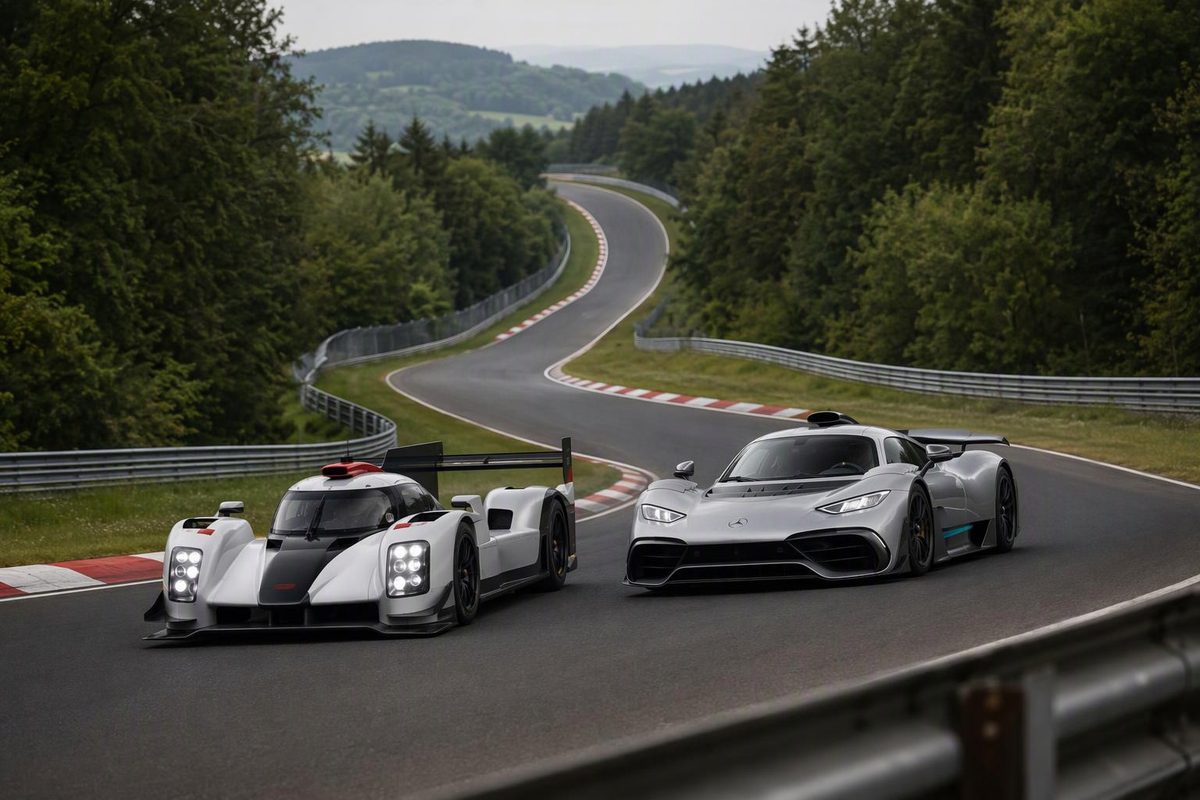
The Nordschleife record is 5:19.546 for the Porsche 919 Hybrid Evo; the production-car benchmark is 6:29.090 for the Mercedes-AMG ONE.
The outright Nürburgring Nordschleife lap record is 5:19.546, set by Timo Bernhard in the Porsche 919 Hybrid Evo on June 29, 2018.
The production-car record is 6:29.090, set by Maro Engel in the Mercedes-AMG ONE on September 23, 2024.
Both answers are correct, but they describe fundamentally different machinery. The first is the circuit’s absolute benchmark; the second is the fastest lap by a production road car.
| Record | Time | Driver | Car | Date | Lap length |
|---|---|---|---|---|---|
| Outright Nordschleife | 5:19.546 | Timo Bernhard | Porsche 919 Hybrid Evo | June 29, 2018 | 20.832 km |
| Production car | 6:29.090 | Maro Engel | Mercedes-AMG ONE | September 23, 2024 | 20.832 km |
Records current through September 28, 2026.
Outright record: Porsche 919 Hybrid Evo, 5:19.546
Bernhard completed the full 20.832-kilometre Nordschleife at an average speed of 233.8 km/h (145.3 mph). The Nürburgring still identified 5:19.546 as the unbeaten all-time record in its review of the official 2025 attempts (Nürburgring).
The 919 Hybrid Evo was neither a production car nor a car competing under contemporary race regulations. Porsche developed it from its Le Mans-winning 919 Hybrid after withdrawing from the World Endurance Championship and freed it from WEC restrictions. The resulting Evo had a claimed system output of 1,160 hp, weighed 849 kg without driver ballast and used active aerodynamics and special Michelin tyre compounds. Its 369.4 km/h top speed is striking, but the record is the elapsed lap time—not the highest speed reached (Porsche).
The lap lowered Stefan Bellof’s long-standing 6:11.13 benchmark by 51.58 seconds. Bellof recorded that time in a Porsche 956 during qualifying for the 1983 Nürburgring 1,000-kilometre race. Porsche notes that construction work made the course used for that lap slightly shorter than the usual layout (Porsche). It was a qualifying lap, not a production-car test.
Production-car record: Mercedes-AMG ONE, 6:29.090
Engel’s 2024 lap made the AMG ONE the first production car officially below 6 minutes 30 seconds around the full Nordschleife. It improved the same car-and-driver combination’s previous record by more than five seconds.
For the 2024 attempt, TÜV Rheinland checked and documented that the car was in standard condition, and a notary confirmed the run. The car used the standard Michelin Pilot Sport Cup 2 R MO tyres available to AMG ONE customers (Mercedes-Benz).
That production-specification check is the key distinction. A purpose-built prototype can set the outright fastest time, but it cannot claim the production-car record merely by going faster.
Why Nürburgring times need labels
“Nürburgring lap record” is incomplete unless the track layout and vehicle category are stated. The records above are for the Nordschleife, not the separate Grand Prix circuit.
For official Nordschleife attempts, the Nürburgring specifies a 20.832-kilometre flying lap beginning and ending at the T13 start/finish line. Calibrated timing equipment and a notary are used, while production vehicles undergo an independent check of their standard condition. The circuit classifies vehicles using German Federal Motor Transport Authority categories (Nürburgring record rules).
The Nürburgring has officially confirmed and listed record attempts under this framework since 2019. Times from a different vehicle category, a shorter layout or a public-session “bridge-to-gantry” run therefore should not be compared directly with these records. A useful Nürburgring time always needs four fields: time, driver, vehicle category and measured layout.